On-Device AI: 5 Benefits for US Smartphone Users in 2026

The landscape of mobile technology is undergoing a profound transformation, with Artificial Intelligence (AI) moving from distant cloud servers directly onto our smartphones. This shift, known as on-device AI, is set to redefine how U.S. smartphone users interact with their devices by 2026. No longer just a buzzword, on-device AI promises a suite of tangible benefits that will make our daily digital lives more efficient, secure, and personalized.
For years, AI capabilities in smartphones largely relied on cloud processing. This meant data had to be sent to remote servers for analysis and then sent back, introducing latency, privacy concerns, and a reliance on internet connectivity. The advent of specialized AI chips (Neural Processing Units or NPUs) embedded directly into smartphone hardware has changed this paradigm. These powerful, energy-efficient chips allow complex AI computations to occur locally, right on your device.
The implications of this shift are vast, especially for the average American smartphone user. From enhanced privacy and lightning-fast performance to truly personalized experiences, on-device AI is not just an incremental upgrade; it’s a fundamental re-imagining of what a smartphone can do. In this comprehensive guide, we will delve into the five key benefits that U.S. smartphone users can expect from the widespread adoption of on-device AI by 2026.
1. Unprecedented Privacy and Security Enhancements with On-Device AI
One of the most significant advantages of on-device AI is the dramatic improvement in user privacy and data security. When AI processing happens directly on your smartphone, sensitive personal data – your photos, messages, voice commands, biometric information, and location data – never has to leave your device. This fundamental change mitigates numerous risks associated with cloud-based AI.
Keeping Your Data Local: The Privacy Revolution
Traditionally, for AI features like advanced photo editing, voice assistants, or personalized recommendations to work, your data would often be uploaded to cloud servers. While companies implement security measures, any data transmitted or stored externally inherently carries a risk of breaches or unauthorized access. With on-device AI, the processing of this data occurs within the secure confines of your smartphone’s hardware. This means:
- Reduced Exposure: Less data leaves your device, significantly reducing the attack surface for cybercriminals.
- Enhanced Control: Users gain more direct control over their data, as it remains under their direct physical possession.
- Compliance with Regulations: This architecture naturally aligns with evolving data privacy regulations like GDPR and CCPA, as less personal data is collected and processed by third-party servers.
Consider the implications for facial recognition, voice authentication, or even predictive text. Instead of sending your facial scan or voiceprint to a remote server for verification, on-device AI handles the comparison locally, ensuring these highly sensitive biometrics remain private. This is a game-changer for trust in mobile technology.
Advanced On-Device Security Features
Beyond simply keeping data local, on-device AI also powers more sophisticated security features directly on the device. AI can be used to:
- Detect Anomalous Behavior: Your smartphone can learn your usage patterns. If an unusual login attempt, app behavior, or network connection occurs, on-device AI can flag it instantly, even without an internet connection, providing real-time threat detection.
- Strengthen Biometrics: AI algorithms can enhance the accuracy and robustness of fingerprint scanners and facial recognition systems, making them harder to spoof while simultaneously improving the user experience.
- Secure Data Enclaves: Modern smartphone architectures often include secure enclaves where cryptographic keys and sensitive data are stored. On-device AI can manage and protect access to these enclaves more intelligently, ensuring only authorized processes can interact with critical information.
- Malware Detection: AI models trained to identify malware signatures and behavioral patterns can run continuously in the background on your device, providing an always-on layer of protection that doesn’t rely on constant cloud updates or consume excessive bandwidth.
By 2026, U.S. smartphone users will experience a new level of digital peace of mind, knowing that their most personal information is being processed and protected right where it belongs: on their own device. This shift towards local processing is a cornerstone of a more secure and private mobile future, making privacy one of the most compelling on-device AI benefits.
2. Lightning-Fast Performance and Responsiveness
The second major benefit that on-device AI brings to U.S. smartphone users is a noticeable boost in performance and responsiveness. By eliminating the need to send data to the cloud for processing, smartphones can execute AI-powered tasks almost instantaneously, leading to a smoother and more fluid user experience across the board.
Eliminating Latency: The Speed Advantage
Cloud-based AI inherently suffers from latency – the delay caused by data traveling from your device to a remote server and back. This delay, while sometimes imperceptible, can add up, especially for real-time applications. When AI computations are performed locally by dedicated NPUs, this latency is virtually eliminated.
- Instantaneous AI Features: Imagine real-time language translation, advanced camera features like object recognition or scene optimization, or even complex video editing tools that respond without any lag. On-device AI makes these experiences seamless.
- Faster App Launch and Operation: Apps that leverage AI for features like content recommendations, smart search, or adaptive interfaces will launch quicker and operate more smoothly, as their AI components are always ready and locally accessible.
- Improved User Interface (UI) Responsiveness: The entire UI can become more responsive. For example, predictive touch, where the phone anticipates your next tap, or dynamic UI adjustments based on your context, can be executed with zero delay, making the phone feel incredibly fluid.
Enhanced Computational Power for Everyday Tasks
Modern NPUs are not just fast; they are incredibly efficient at handling the specific types of mathematical operations required for AI and machine learning tasks. This specialized hardware offloads these intensive computations from the main CPU, freeing it up for other tasks and leading to overall better system performance.
- Superior Camera Capabilities: On-device AI enables advanced computational photography in real-time. This includes features like instant HDR processing, superior low-light performance, advanced portrait modes with precise bokeh, and intelligent scene detection that adjusts settings before you even press the shutter. The result is professional-grade photos and videos captured effortlessly.
- Real-time Voice and Language Processing: Voice assistants become faster and more accurate. Speech-to-text conversion happens in real-time with fewer errors, and real-time translation can occur during conversations or when pointing your camera at text, all without a network connection.
- Efficient Resource Management: AI can intelligently manage system resources, optimizing battery life by putting less frequently used apps to sleep, predicting your usage patterns to pre-load content, or adjusting screen brightness based on your environment and habits.
By 2026, U.S. smartphone users will come to expect this level of instantaneous responsiveness as the norm. The days of waiting for AI-powered features to ‘think’ will be largely over, replaced by a fluid, immediate, and highly efficient interaction with their devices. This speed and efficiency are undeniable on-device AI benefits that will enhance daily productivity and enjoyment.
3. Deeply Personalized User Experiences
The third transformative benefit of on-device AI is its ability to deliver truly personalized user experiences that adapt and evolve with each individual. Because AI can process and learn from your local data without sending it to the cloud, it gains a much deeper and more nuanced understanding of your preferences, habits, and context, leading to a smartphone that genuinely feels like it was made just for you.
AI That Learns You, Locally and Privately
Imagine a smartphone that doesn’t just react to your commands but proactively anticipates your needs, offers relevant suggestions, and customizes its interface based on your current situation. This is the promise of on-device AI. By analyzing data directly on your device – your app usage, communication patterns, location history, media consumption, and even your biometric responses – the AI can build a rich, private profile of your digital life.
- Proactive Assistance: Your phone might suggest leaving for work earlier due to unexpected traffic, even before you check your navigation app, based on your calendar, current location, and learned commuting habits.
- Context-Aware Adjustments: The device could automatically switch to silent mode when you enter a meeting room (detected via calendar and location), adjust notification priorities based on who is contacting you and your current activity, or optimize display settings based on ambient light and your typical viewing preferences.
- Tailored Content Curation: News feeds, music playlists, and video recommendations will become hyper-personalized, not just based on what you’ve explicitly liked, but on subtle patterns in your consumption behavior that only a local AI can intimately understand.
Adaptive Interfaces and Predictive Interactions
The personalization extends beyond content to the very interface of your smartphone. On-device AI can dynamically adjust the layout, shortcuts, and available features to match your current context and predicted needs.
- Dynamic Home Screens: Your home screen might reconfigure itself throughout the day, showing work-related apps during business hours, entertainment apps in the evening, and travel tools when you’re at an airport.
- Predictive Text and Suggestions: Beyond simple word prediction, AI can learn your unique writing style, common phrases, and even the tone you use in different contexts, offering more accurate and contextually relevant suggestions for messages and emails.
- Smart Notifications: Instead of a flood of alerts, on-device AI can intelligently prioritize notifications, suppressing less important ones when you’re busy and highlighting critical ones, learning over time what truly matters to you.
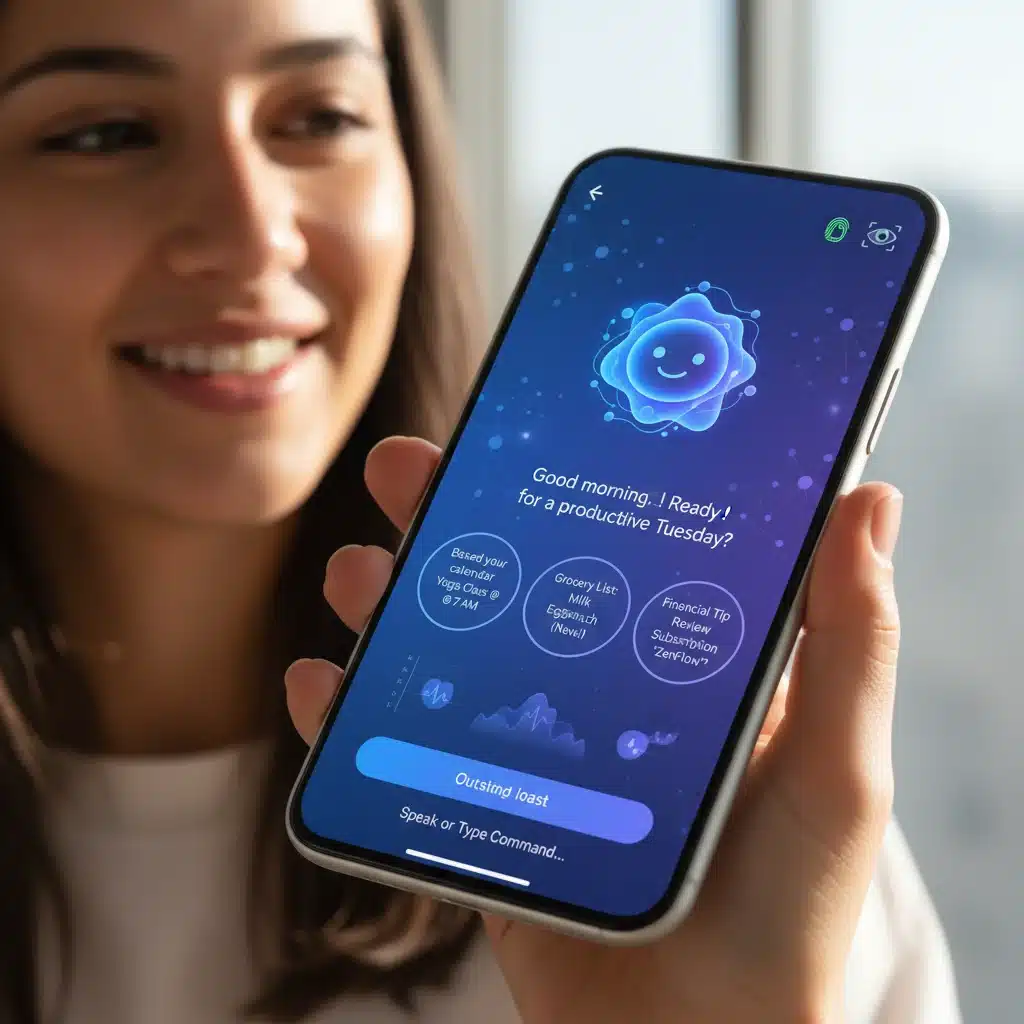
By 2026, U.S. smartphone users will experience devices that feel incredibly intuitive and anticipate their desires, making their digital interactions smoother and more efficient. This deep level of personalized experience, achieved while maintaining privacy, is a hallmark of the on-device AI revolution.
4. Robust Offline Capabilities and Reduced Data Usage
The fourth significant benefit of on-device AI is the dramatic enhancement of offline capabilities and a corresponding reduction in reliance on constant internet connectivity. For U.S. smartphone users, this means greater freedom, functionality in remote areas, and potentially lower mobile data bills.
Full Functionality, Anywhere, Anytime
Many of the AI features we’ve come to rely on today often require an active internet connection to communicate with cloud servers. With on-device AI, these functionalities become available even when you’re completely offline – whether you’re on a subway, hiking in a national park, or traveling internationally without a local SIM card.
- Offline Voice Assistants: Imagine being able to set alarms, make calls, send messages, control smart home devices, or get directions using your voice assistant, all without a network connection. Basic commands and contextual queries can be processed entirely on your device.
- Advanced Offline Translation: Real-time language translation, both for voice and text, becomes fully functional offline. This is invaluable for travelers or anyone needing to communicate across language barriers without incurring data roaming charges or searching for Wi-Fi.
- Offline Image and Video Processing: Features like object recognition in photos, advanced photo editing filters, video stabilization, and even basic video summarization can be performed offline, allowing for creative work and organization even in remote locations.
- Enhanced Offline Navigation: While maps themselves might need to be downloaded, on-device AI can power more intelligent offline navigation, adapting routes based on learned preferences, real-time local sensor data, and even recognizing landmarks through your camera to orient you.
Significant Reduction in Data Consumption
By processing AI tasks locally, smartphones drastically reduce the amount of data that needs to be sent to and from the cloud. This translates into tangible benefits for users:
- Lower Data Bills: For users with limited data plans, executing AI tasks locally can save significant amounts of data, leading to lower monthly costs.
- Extended Battery Life: While NPUs consume power, the power required to constantly transmit data over cellular networks can often be higher, especially for large AI models. Local processing can be more energy-efficient in many scenarios.
- Faster Performance in Congested Areas: Even when an internet connection is available, crowded networks (like at concerts or major events) can slow down cloud-based AI. On-device AI bypasses these bottlenecks, ensuring consistent performance.

The freedom and reliability offered by robust offline capabilities will be a game-changer for many U.S. smartphone users by 2026, making their devices truly indispensable companions regardless of network availability. This is a crucial aspect of the on-device AI benefits that often goes underappreciated until experienced.
5. Greater Accessibility and Inclusivity
The fifth, and often overlooked, significant benefit of on-device AI is its profound impact on accessibility and inclusivity. By bringing advanced AI capabilities directly to the device, smartphones can become more powerful tools for individuals with disabilities, bridging gaps and providing more equitable access to digital information and services.
Empowering Users with Diverse Needs
On-device AI can power a new generation of accessibility features that are faster, more reliable, and more personalized than ever before. Since processing happens locally, these features can operate without latency and without requiring a constant internet connection, making them available in critical moments.
- Advanced Screen Readers and Text-to-Speech: AI can improve the naturalness and accuracy of screen readers, making digital content more comprehensible for visually impaired users. It can also adapt its speaking style and speed based on user preferences and context.
- Real-time Captioning and Transcription: For individuals who are deaf or hard of hearing, on-device AI can provide highly accurate, real-time captions for audio and video content, as well as live conversations, directly on the device. This includes transcribing spoken words into text, even in noisy environments, without sending audio to the cloud.
- Enhanced Voice Control and Navigation: Voice interfaces powered by local AI can become more robust, understanding a wider range of accents and speech patterns, and allowing for more nuanced control of the device for users with motor impairments. This reduces the frustration often associated with cloud-dependent voice recognition.
- Object and Scene Recognition for the Visually Impaired: AI can analyze camera feeds in real-time to describe surroundings, identify objects, read signs, and even describe people’s expressions, providing crucial environmental information to visually impaired users, enhancing their independence and safety.
- Personalized Cognitive Assistance: For individuals with cognitive disabilities, AI can offer personalized reminders, simplify complex interfaces, or provide step-by-step guidance for tasks, adapting to individual learning styles and needs.
Breaking Down Digital Barriers
The independence from cloud services is particularly important for accessibility features. A person relying on real-time captions or object recognition cannot afford delays or interruptions due to poor network connectivity. On-device AI ensures these critical tools are always available and perform optimally.
Furthermore, the privacy benefits of on-device AI are crucial when dealing with sensitive personal data that might be used by accessibility features, such as voice patterns, facial expressions, or environmental audio. Keeping this data local builds trust and encourages wider adoption of these empowering technologies.
By 2026, smartphones will become even more powerful assistive devices, thanks to the capabilities of on-device AI. This will foster a more inclusive digital world where technology adapts to individual needs, rather than requiring individuals to adapt to technology. This commitment to accessibility is one of the most impactful on-device AI benefits for society as a whole.
The Future is Local: Embracing On-Device AI in the U.S.
The shift towards on-device AI represents a pivotal moment in the evolution of smartphone technology. By 2026, U.S. smartphone users will no longer view AI as a distant, cloud-dependent utility but as an integral, always-on, and deeply personal component of their mobile experience. The five key benefits we’ve explored – unparalleled privacy and security, lightning-fast performance, profoundly personalized experiences, robust offline capabilities, and enhanced accessibility – paint a picture of a future where our smartphones are more powerful, intuitive, and trustworthy than ever before.
This technological leap is not just about faster chips or fancier features; it’s about fundamentally changing our relationship with our most personal device. It’s about giving users more control, more freedom, and a more seamless integration of technology into their daily lives, all while safeguarding their most valuable asset: their data.
As manufacturers continue to innovate with more powerful NPUs and developers create applications that fully leverage these local AI capabilities, the smartphone of 2026 will be a testament to the transformative power of intelligence at the edge. Get ready to experience a new era of mobile computing, where the intelligence is not just in the cloud, but right in the palm of your hand.