Decoding 2026 U.S. Privacy Regulations: Mobile App Impact

Decoding the Latest 2026 U.S. Privacy Regulations: How 4 Key Tech Updates Impact Your Mobile App Usage
The digital landscape is in a constant state of evolution, and with it, the necessity for robust data protection measures. As we approach 2026, the United States is poised to introduce a new wave of U.S. Privacy Regulations 2026, promising a significant overhaul in how personal data is collected, processed, and shared, particularly within the realm of mobile applications. These forthcoming regulations are not merely minor adjustments; they represent a fundamental shift designed to empower users and hold technology companies to a higher standard of accountability. For anyone who uses a smartphone or develops mobile apps, understanding these changes is paramount. This comprehensive guide will delve into the intricacies of the U.S. Privacy Regulations 2026, exploring four pivotal technological updates that will reshape your mobile app experience and dictate the future of data privacy.
The journey towards more stringent data privacy began years ago with landmark legislation such as the GDPR in Europe and the CCPA in California. These pioneering efforts laid the groundwork for a global conversation about user rights and corporate responsibilities regarding personal data. The U.S. Privacy Regulations 2026 are expected to build upon these precedents, aiming to create a more unified and comprehensive framework across the diverse legal landscape of the United States. This will undoubtedly impact everything from app design and data collection practices to user consent mechanisms and data breach responses. Our focus will be on the practical implications for mobile app users and developers, ensuring you are well-equipped to navigate this new regulatory environment.
The Impending Shift: What are the 2026 U.S. Privacy Regulations?
Before diving into the technological specifics, it’s crucial to grasp the overarching philosophy behind the U.S. Privacy Regulations 2026. While details are still being finalized and states continue to legislate, the general consensus points towards a federal framework that emphasizes user consent, data minimization, transparency, and accountability. This means users will likely have greater control over their data, including the right to access, correct, delete, and port their personal information. Companies, in turn, will face stricter obligations regarding how they handle this data, from initial collection to eventual deletion.
One of the primary drivers behind these regulations is the exponential growth of data collection by mobile applications. From location data and browsing habits to health information and financial transactions, apps gather an unprecedented amount of personal information. The existing patchwork of state-level laws has proven insufficient to address the complexities of this data ecosystem, leading to calls for a more coherent national strategy. The U.S. Privacy Regulations 2026 aim to provide this much-needed clarity and consistency, creating a level playing field for businesses and enhanced protection for consumers.
Key components expected in the U.S. Privacy Regulations 2026 include:
- Expanded Definition of Personal Data: A broader scope of what constitutes ‘personal data’ to include identifiers like IP addresses, device IDs, and biometric information.
- Universal Opt-Out Mechanisms: The introduction of standardized, easy-to-use mechanisms for users to opt out of data collection and sharing across all apps and platforms.
- Data Protection Assessments: Mandatory assessments for companies to identify and mitigate privacy risks associated with new technologies and data processing activities.
- Enhanced Enforcement Powers: Greater authority for regulatory bodies to investigate and penalize companies for non-compliance, including significant financial penalties.
- Data Minimization Principles: Encouraging apps to collect only the data absolutely necessary for their stated purpose, reducing the risk of data misuse.
These principles will form the bedrock upon which the new regulatory landscape is built, directly influencing how mobile apps are designed, developed, and monetized. For users, this translates to a potentially more secure and transparent mobile experience, where their digital footprint is more explicitly under their control. For developers, it means re-evaluating existing data practices and potentially investing in new technologies and processes to ensure compliance with the U.S. Privacy Regulations 2026.
Key Tech Update 1: Decentralized Identity and Self-Sovereign Data Management
One of the most transformative shifts anticipated with the U.S. Privacy Regulations 2026 is the accelerating move towards decentralized identity (DID) and self-sovereign identity (SSI). Currently, our digital identities are largely managed by centralized entities – social media platforms, email providers, and various online services. This model presents significant privacy risks, as these entities become honeypots for personal data, making them prime targets for cyberattacks and data breaches. SSI, powered by blockchain technology, offers an alternative where individuals have complete control over their digital identity and personal data.
Imagine a future where you, the user, hold verifiable credentials (e.g., your age, educational qualifications, medical records) directly on your device or in a secure digital wallet. When an app requires certain information, instead of sharing your entire profile, you can selectively disclose only the necessary attributes, cryptographically verified by the issuing authority. For instance, an age-restricted app could verify you are over 18 without ever knowing your birthdate or full name. This paradigm shift aligns perfectly with the data minimization and user control principles of the U.S. Privacy Regulations 2026.
For mobile apps, this means a fundamental rethinking of user onboarding and authentication processes. Apps will need to integrate with DID frameworks, allowing users to present verifiable credentials rather than creating new accounts with redundant data inputs. This not only enhances user privacy but can also streamline the user experience by reducing the friction of account creation. Developers will need to understand the underlying cryptographic principles and integrate secure wallet functionalities into their applications, ensuring that user data remains truly self-sovereign.
The implications are profound:
- Reduced Data Footprint: Apps will store less sensitive personal data, minimizing their liability in case of a breach.
- Enhanced User Control: Users decide precisely what information to share and with whom.
- Improved Security: Decentralized systems are inherently more resilient to large-scale data breaches targeting central databases.
- Simplified Compliance: By adhering to SSI principles, apps can more easily meet the data minimization and consent requirements of the U.S. Privacy Regulations 2026.
The integration of decentralized identity solutions will be a cornerstone of privacy-preserving mobile app development under the new U.S. Privacy Regulations 2026, empowering users with unprecedented control over their digital lives.
Key Tech Update 2: Advanced Data Anonymization and Differential Privacy Techniques
While data minimization is crucial, many apps still rely on aggregated data for analytics, service improvement, and personalized experiences. The challenge lies in doing this without compromising individual privacy. The U.S. Privacy Regulations 2026 will likely push for widespread adoption of advanced data anonymization and privacy-enhancing technologies (PETs), with differential privacy leading the charge.
Traditional anonymization methods have often proven insufficient, as it’s frequently possible to re-identify individuals from supposedly anonymized datasets by cross-referencing with other publicly available information. Differential privacy, on the other hand, provides a stronger, mathematically provable guarantee of privacy. It works by injecting a carefully calibrated amount of statistical noise into datasets, making it impossible to determine whether any single individual’s data is included in the dataset, even for an attacker with access to auxiliary information. Despite this noise, the overall statistical properties of the dataset remain accurate enough for meaningful analysis.
For mobile app developers, this means moving beyond simple data masking or aggregation. Apps that collect large volumes of user data for analytical purposes will need to implement differential privacy techniques to ensure compliance with the U.S. Privacy Regulations 2026. This could involve using client-side differential privacy, where noise is added to individual data points before they leave the user’s device, or server-side implementations for aggregated data.
The practical applications for mobile apps are vast:
- Anonymous Usage Analytics: Understanding user behavior and app performance without tracking individuals.
- Personalized Recommendations (Privacy-Preserving): Delivering relevant content or product suggestions without directly knowing a user’s specific preferences, but rather their general demographic or behavioral patterns within a differentially private framework.
- Location-Based Services: Providing aggregated traffic or crowd density information without revealing individual locations.
- Federated Learning: Training machine learning models on decentralized datasets (e.g., on individual devices) without centralizing the raw data, thereby preserving privacy.
Implementing differential privacy requires specialized expertise in data science and cryptography. Mobile app development teams will need to acquire or partner with experts in these fields to ensure their data processing practices meet the stringent privacy requirements of the U.S. Privacy Regulations 2026, allowing them to extract valuable insights while safeguarding user privacy.
Key Tech Update 3: Enhanced Consent Management Platforms (CMPs) and Granular Permissions
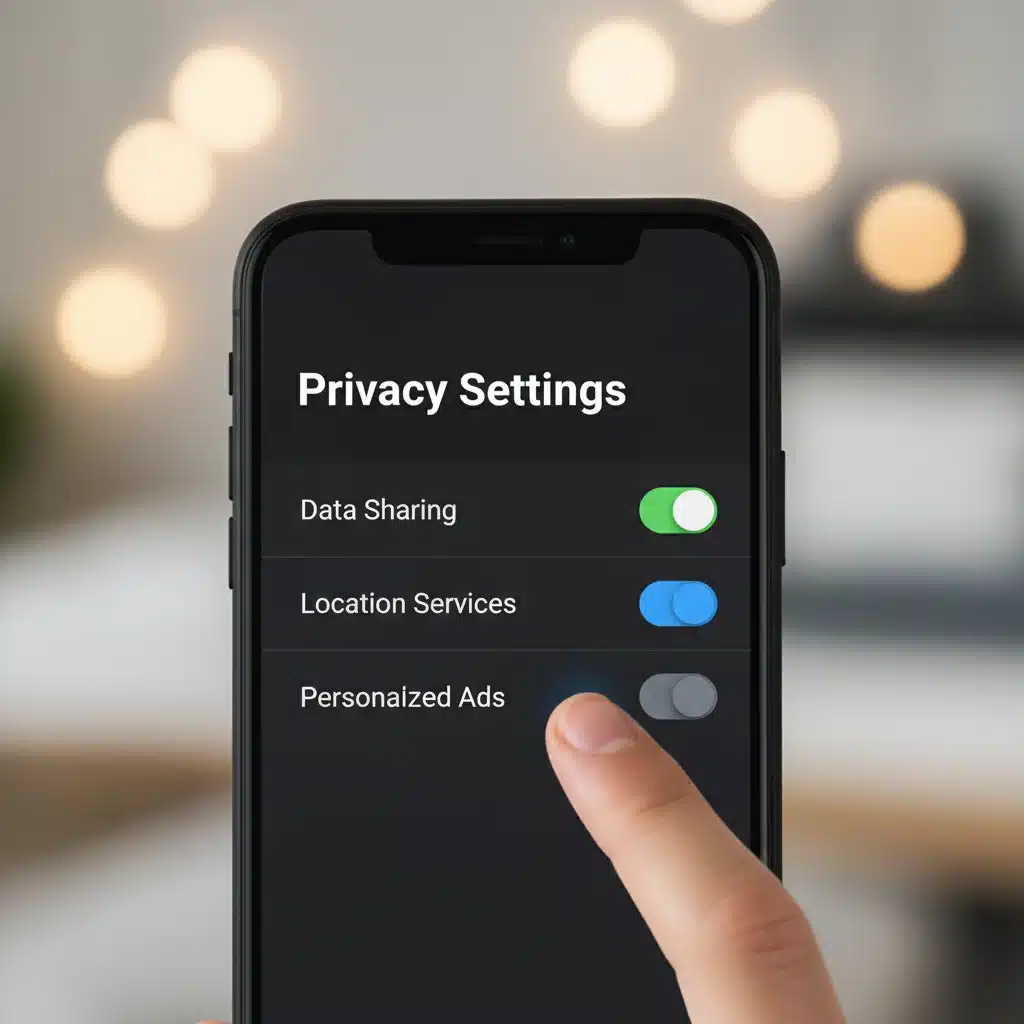
User consent is at the heart of modern privacy regulations, and the U.S. Privacy Regulations 2026 will undoubtedly elevate its importance. Gone are the days of vague, all-encompassing terms of service that users blindly accept. The new regulations will demand explicit, informed, and granular consent for various data processing activities within mobile apps. This necessitates a significant upgrade in how apps manage and record user permissions.
Consent Management Platforms (CMPs) will become indispensable tools for mobile app developers. These platforms provide a standardized way to request, record, and manage user consent for different types of data collection and usage. Under the U.S. Privacy Regulations 2026, users will expect not just an ‘accept all cookies’ button, but clear, understandable options to consent to specific data uses, such as analytics, personalized advertising, or sharing with third parties. Furthermore, users will likely have the right to easily withdraw consent at any time, requiring apps to have robust mechanisms for revoking permissions and ceasing data processing.
Granular permissions go hand-in-hand with enhanced CMPs. Instead of a blanket permission for ‘access to photos,’ apps will need to request access to ‘selected photos’ or ‘photos for profile picture only.’ This level of specificity empowers users to make informed decisions about their data and limits the potential for apps to over-collect information. Operating systems like iOS and Android have already started moving in this direction, but the U.S. Privacy Regulations 2026 will push these requirements further, potentially mandating specific UI/UX patterns for consent requests.
The impact on mobile app usage will be immediate and noticeable:
- More Frequent and Detailed Consent Prompts: Users will encounter more explicit requests for permission, requiring careful design to avoid ‘consent fatigue.’
- Easier Access to Privacy Settings: Apps will need prominent and intuitive privacy dashboards where users can review and modify their consent preferences.
- Transparency Reports: Some regulations might require apps to provide periodic reports on how user data is being used, based on their consent.
- Conditional Functionality: Certain app features might only become available if the user grants specific permissions, making the relationship between data and functionality clearer.
Developing effective CMPs and implementing granular permissions will be a critical compliance challenge for mobile app developers under the U.S. Privacy Regulations 2026. It requires a user-centric design approach that prioritizes clarity, control, and transparency.
Key Tech Update 4: Privacy-Preserving Machine Learning (PPML) and On-Device Processing
Machine learning (ML) models are integral to many mobile app functionalities, from personalized feeds to predictive text. However, training these models often requires vast amounts of personal data, which can raise significant privacy concerns. The U.S. Privacy Regulations 2026 will likely accelerate the adoption of Privacy-Preserving Machine Learning (PPML) techniques and a shift towards more on-device processing.
PPML encompasses various methods designed to train and deploy ML models while protecting the privacy of the underlying data. Techniques like Federated Learning, already mentioned in the context of differential privacy, allow models to be trained collaboratively on decentralized datasets without the raw data ever leaving the user’s device. Homomorphic Encryption, another advanced PPML technique, enables computations to be performed on encrypted data, meaning the data remains encrypted even during processing, preventing unauthorized access.
Furthermore, the increasing computational power of modern smartphones is making on-device processing more viable. Instead of sending sensitive user data to cloud servers for ML inference, many tasks can now be performed directly on the device. This significantly reduces the privacy risk by keeping data local and minimizing its exposure to external systems. For example, image recognition for photo categorization or natural language processing for smart replies can often be handled entirely on a user’s phone, aligning perfectly with the data minimization and security goals of the U.S. Privacy Regulations 2026.
The implications for mobile apps and user experience include:
- Enhanced Privacy for AI Features: Users can benefit from intelligent app features without their personal data being sent to the cloud for analysis.
- Offline Functionality: More ML-powered features can work without an internet connection, improving reliability and accessibility.
- Reduced Latency: Processing data on-device often leads to faster response times for ML-driven features.
- Lower Bandwidth Usage: Less data needs to be uploaded to cloud servers, conserving mobile data and battery life.
Implementing PPML and optimizing for on-device processing will require significant engineering effort from mobile app developers. It involves understanding complex cryptographic methods, optimizing ML models for resource-constrained environments, and designing secure data flows. However, the investment will be crucial for building trust with users and ensuring compliance with the U.S. Privacy Regulations 2026, ultimately leading to a new generation of privacy-first intelligent applications.
Navigating the Future: Challenges and Opportunities for Mobile Apps
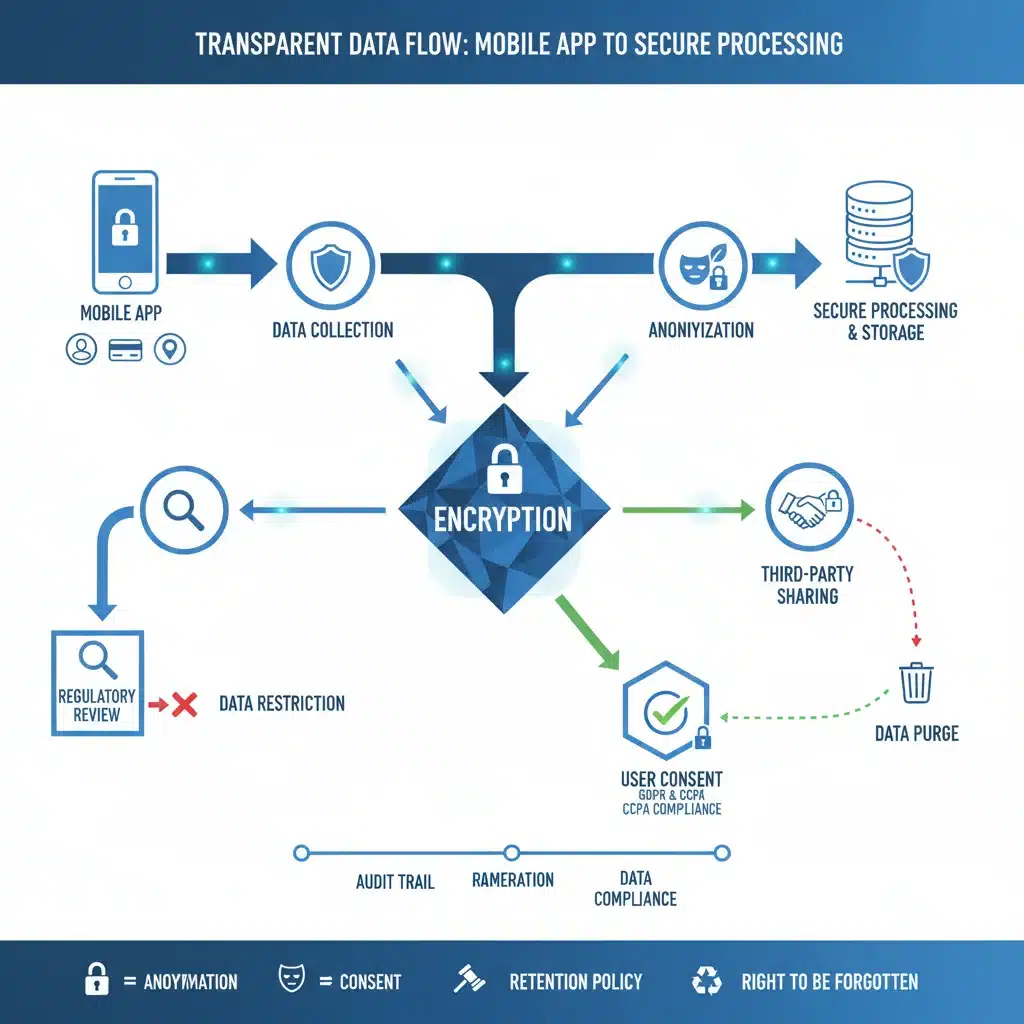
The U.S. Privacy Regulations 2026, coupled with these four key technological updates, present both formidable challenges and exciting opportunities for the mobile app ecosystem. Compliance will not be a trivial task. Developers and companies will need to invest heavily in understanding the new legal landscape, re-architecting their data pipelines, and adopting new privacy-enhancing technologies. This may involve significant upfront costs, retraining staff, and potentially rethinking business models that heavily rely on extensive data collection.
One of the primary challenges will be the fragmentation of privacy laws within the U.S. While a federal framework is anticipated, it’s likely that state-specific regulations will continue to exist, potentially creating a complex web of compliance requirements for apps operating nationwide. Developers will need robust legal counsel and flexible technical solutions to navigate these varying demands.
However, these changes also open up significant opportunities. Apps that prioritize user privacy and proactively adopt these advanced technologies will build greater trust with their users. In an increasingly privacy-conscious world, trust is a valuable commodity. Users are more likely to engage with and remain loyal to apps that demonstrate a clear commitment to protecting their personal information. This can lead to increased user acquisition, higher retention rates, and a stronger brand reputation.
Furthermore, the focus on data minimization and efficient processing can lead to more streamlined and performant applications. By only collecting essential data and processing it locally or with privacy-preserving methods, apps can become more efficient, consume less battery, and offer a smoother user experience. This efficiency can also translate into reduced infrastructure costs for developers, as less data needs to be stored and managed in centralized cloud environments.
The U.S. Privacy Regulations 2026 will also foster innovation. The demand for privacy-preserving solutions will drive the development of new tools, frameworks, and methodologies. This could lead to a vibrant ecosystem of privacy-focused startups and technologies, benefiting the entire digital landscape. Developers who embrace these changes early will be at the forefront of this innovation, positioning themselves as leaders in the next generation of mobile app development.
Preparing for 2026: A Roadmap for Developers and Users
For mobile app developers, preparation for the U.S. Privacy Regulations 2026 should begin now. A comprehensive roadmap would include:
- Conduct a Data Audit: Understand what data your app collects, why it collects it, where it’s stored, and who has access to it.
- Review Legal Counsel: Engage privacy legal experts to interpret the specific requirements of the new regulations and ensure your app’s practices are compliant.
- Implement Privacy by Design: Integrate privacy considerations into every stage of the app development lifecycle, from conception to deployment.
- Invest in PETs: Explore and integrate technologies like decentralized identity, differential privacy, and homomorphic encryption where appropriate.
- Enhance Consent Mechanisms: Develop user-friendly and granular CMPs that provide clear choices and easy withdrawal of consent.
- Train Your Team: Educate developers, designers, and marketing teams on the new regulations and best practices for data privacy.
- Prepare for Data Subject Rights: Establish clear processes for users to exercise their rights to access, correct, delete, and port their data.
For mobile app users, being aware of these upcoming changes is equally important. Here’s how you can prepare:
- Stay Informed: Follow reputable sources for updates on the U.S. Privacy Regulations 2026 and their impact.
- Review App Permissions: Regularly check and adjust the permissions granted to your mobile apps on your device settings.
- Read Privacy Policies (Carefully): Pay closer attention to how apps explain their data practices, especially after the new regulations take effect.
- Utilize Privacy Tools: Take advantage of built-in privacy features in your operating system and any new tools offered by apps to manage your data.
- Demand Transparency: Support apps and companies that are transparent about their data practices and prioritize user privacy.
The U.S. Privacy Regulations 2026 represent a pivotal moment for digital privacy. By understanding the regulations and the technological advancements they will spur, both developers and users can contribute to a more secure, transparent, and user-centric mobile app ecosystem. The future of mobile app usage is one where privacy is not an afterthought but a fundamental right, woven into the very fabric of our digital interactions.
Conclusion
The advent of the U.S. Privacy Regulations 2026 marks a significant milestone in the ongoing effort to establish robust data protection standards in the digital age. These regulations, combined with the transformative potential of decentralized identity, advanced anonymization, enhanced consent management, and privacy-preserving machine learning, are set to fundamentally alter how mobile applications interact with user data. For consumers, this promises a future of greater control, transparency, and security over their personal information. For developers and businesses, it necessitates a proactive approach to compliance, innovation, and a renewed commitment to ethical data practices.
Embracing these changes is not merely about avoiding penalties; it’s about building a more trustworthy and sustainable digital ecosystem. Apps that lead with privacy will not only meet regulatory requirements but will also forge stronger relationships with their users, fostering loyalty and driving long-term success. As we move closer to 2026, the mobile app landscape will undoubtedly be reshaped, emerging as a more secure and user-empowered environment, thanks to these crucial U.S. Privacy Regulations 2026 and the technological innovations they inspire. The journey ahead will require adaptability, foresight, and a shared commitment to protecting the digital rights of every individual.