Edge AI in US Mobile Tech: Revolutionizing Data Processing by 2026
The Rise of Edge AI: Practical Solutions for Data Processing in US Mobile Tech by 2026
The landscape of mobile technology is undergoing a profound transformation, driven by an insatiable demand for faster, more intelligent, and more secure computing. At the forefront of this revolution is Edge AI Mobile Tech – a paradigm shift that brings artificial intelligence directly to mobile devices and the ‘edge’ of the network, rather than relying solely on centralized cloud infrastructure. By 2026, the United States mobile technology sector is poised to witness an unprecedented integration of Edge AI, fundamentally altering how data is processed, analyzed, and leveraged.
This comprehensive article will delve into the critical aspects of Edge AI in US mobile tech, exploring its practical solutions, the myriad benefits it offers, and the challenges that must be navigated. We will examine how this technology is not just an incremental improvement but a foundational change that will reshape user experiences, business operations, and the very fabric of our connected lives.
Understanding Edge AI: Beyond the Cloud
To fully grasp the significance of Edge AI Mobile Tech, it’s essential to understand what Edge AI entails. Traditionally, AI processing has been heavily reliant on powerful, centralized cloud servers. Data generated by mobile devices would be transmitted to these distant data centers, processed, and then the results sent back to the device. While effective for many applications, this model introduces inherent limitations:
- Latency: The round-trip journey to the cloud can introduce delays, making real-time applications challenging.
- Bandwidth: Transmitting vast amounts of raw data consumes significant network bandwidth, especially with the proliferation of high-resolution sensors and multimedia.
- Privacy and Security: Sending sensitive data to the cloud raises concerns about data privacy and potential security breaches.
- Cost: Cloud computing can be expensive, with costs scaling rapidly as data volumes increase.
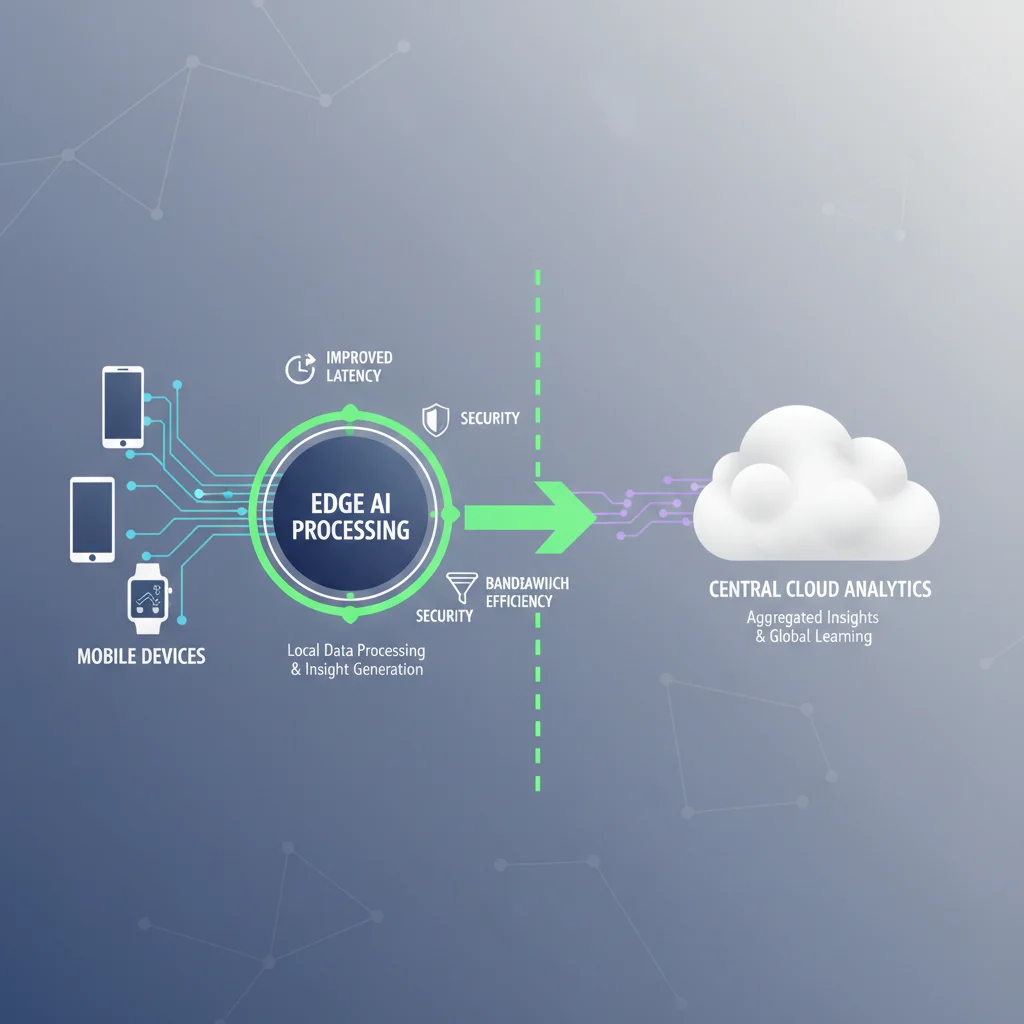
Edge AI addresses these challenges by moving AI computations closer to the data source – directly onto the mobile device itself or nearby edge servers. This ‘edge’ can be a smartphone, a wearable, an IoT device, or a localized micro-data center. By processing data at the source, Edge AI significantly reduces latency, conserves bandwidth, enhances data privacy, and can often be more cost-effective for specific use cases.
The rise of powerful mobile processors, specialized AI accelerators (like Neural Processing Units or NPUs), and the widespread deployment of 5G networks are converging to make Edge AI Mobile Tech not just a possibility, but an imperative for the next generation of mobile computing.
Key Drivers for Edge AI Adoption in US Mobile Tech
Several factors are accelerating the adoption of Edge AI Mobile Tech across the US mobile landscape:
The Proliferation of 5G Networks
5G technology is a game-changer for Edge AI. Its ultra-low latency, massive bandwidth, and ability to connect a vast number of devices create the perfect infrastructure for edge computing. With 5G, data can be transmitted to nearby edge servers with minimal delay, enabling real-time AI applications that were previously impossible. This synergy between 5G and Edge AI is particularly crucial for applications requiring instantaneous responses, such as augmented reality, autonomous vehicles, and real-time industrial monitoring.
Increasing Demand for Real-Time Processing
From instant language translation on a smartphone to real-time object recognition in a smart camera, users and applications increasingly demand immediate feedback. Cloud-based AI, with its inherent latency, often falls short. Edge AI Mobile Tech delivers the instantaneous processing required for these critical real-time scenarios, enhancing user experience and enabling new functionalities.
Growing Concerns Over Data Privacy and Security
In an era of heightened awareness around data privacy, processing sensitive information locally on a device or at the edge offers a significant advantage. Instead of sending raw, personal data to a remote cloud, Edge AI can process it on the device, extracting only necessary insights or anonymized data for cloud aggregation. This ‘privacy by design’ approach is becoming a crucial differentiator for mobile applications and services, especially in sectors like healthcare and finance.
Optimization of Bandwidth and Energy Consumption
As the number of connected devices explodes, and each device generates more data, the strain on network bandwidth becomes immense. Edge AI alleviates this by processing data locally, reducing the amount of raw data that needs to be transmitted to the cloud. This not only saves bandwidth but also contributes to energy efficiency, both for the devices (less data transmission means less power consumption) and for the network infrastructure.

Practical Solutions and Use Cases for Edge AI Mobile Tech by 2026
The applications of Edge AI Mobile Tech are vast and varied, promising to touch almost every aspect of our daily lives. Here are some key practical solutions expected to mature by 2026:
Enhanced On-Device AI Assistants
Current AI assistants (Siri, Google Assistant, Alexa) often rely on cloud processing for complex queries. With Edge AI, more sophisticated voice commands, natural language processing, and contextual understanding can occur directly on the device. This means faster responses, greater privacy (as personal requests stay local), and continued functionality even without an internet connection. Imagine an assistant that understands your nuanced requests and adapts to your habits without sending every conversation to a distant server.
Advanced Mobile Photography and Videography
Smartphones already use AI for features like computational photography, scene recognition, and facial enhancements. Edge AI will push these capabilities further, enabling real-time 8K video processing, more accurate depth sensing for AR applications, instant object segmentation, and personalized image adjustments based on user preferences, all processed on the device for immediate results.
Augmented Reality (AR) and Virtual Reality (VR) Experiences
AR and VR demand extremely low latency to provide immersive and convincing experiences. Edge AI is fundamental here, allowing for real-time environment mapping, object recognition, gesture tracking, and rendering directly on AR/VR headsets or smartphones. This will unlock more realistic and interactive AR games, educational tools, and practical applications for industries like retail and manufacturing.
Personalized Health and Fitness Tracking
Wearable devices generate a continuous stream of highly personal health data. Edge AI can process this data locally to detect anomalies, track fitness progress, and provide real-time health insights without constantly sending sensitive information to the cloud. This enables immediate alerts for health risks and more personalized wellness coaching, while safeguarding user privacy.
Intelligent Industrial and Enterprise Mobile Solutions
In enterprise settings, mobile devices are used for everything from inventory management to field service. Edge AI can empower these devices with capabilities like real-time defect detection on production lines via mobile cameras, predictive maintenance alerts for machinery, and optimized logistics routing, all processed locally to ensure operational efficiency and data security within the corporate network.
Smart City and Vehicular Communications
While often associated with fixed infrastructure, mobile devices play a crucial role in smart city initiatives. Edge AI on mobile phones can contribute to localized traffic management, pedestrian safety systems, and even communicate with autonomous vehicles for enhanced situational awareness, processing critical data at the edge for immediate decision-making.
Challenges and Considerations for Edge AI Mobile Tech
Despite its immense potential, the widespread adoption of Edge AI Mobile Tech also presents several challenges that need to be addressed:
Hardware Limitations and Optimization
While mobile processors are becoming incredibly powerful, they still have constraints regarding computational power, memory, and battery life compared to cloud data centers. Developing AI models that are efficient enough to run effectively on resource-constrained edge devices without excessive power consumption is a significant challenge. This requires specialized hardware (NPUs) and highly optimized software frameworks.
Model Development and Deployment
Training large AI models still largely happens in the cloud due to computational demands. The challenge lies in efficiently compressing and deploying these complex models to edge devices, ensuring they perform accurately with limited resources. Furthermore, managing updates and ensuring model consistency across a vast array of diverse mobile devices adds another layer of complexity.
Security at the Edge
While Edge AI enhances privacy by keeping data local, it also introduces new security vulnerabilities. Each edge device becomes a potential attack vector. Robust security measures are required to protect AI models, data, and the device itself from tampering, unauthorized access, and adversarial attacks that could compromise the integrity of the AI’s decisions.
Interoperability and Standardization
The mobile technology ecosystem is highly fragmented, with various operating systems, hardware manufacturers, and AI frameworks. Achieving seamless interoperability and establishing industry-wide standards for Edge AI deployment, data formats, and communication protocols will be crucial for widespread adoption and scalability.
Data Governance and Regulatory Compliance
Even with local processing, data governance remains a critical concern. Regulations like GDPR and CCPA still apply, and understanding how anonymized data or insights derived from local processing are handled and potentially shared with the cloud is vital. Ensuring compliance across diverse applications and geographies will require careful planning.
The Future Outlook: Edge AI and US Mobile Tech by 2026
By 2026, the integration of Edge AI Mobile Tech in the US mobile sector will be pervasive, moving beyond niche applications to become a fundamental component of almost every new device and service. We can anticipate several key trends:
Hyper-Personalization at Scale
Edge AI will enable mobile devices to offer unprecedented levels of personalization. From adaptive user interfaces that learn individual habits to predictive recommendations based on immediate context, mobile experiences will become incredibly tailored, yet privacy-preserving.
Ubiquitous Sensing and Contextual Awareness
Mobile devices will become even more intelligent sensors, capable of understanding their environment and user’s context with remarkable accuracy. Edge AI will process data from cameras, microphones, accelerometers, and other sensors in real-time, allowing devices to proactively assist users and interact intelligently with their surroundings.
Enhanced Device Autonomy and Resilience
With more processing power and intelligence on board, mobile devices will become more autonomous, able to perform complex tasks and make decisions even when disconnected from the cloud. This enhances resilience, particularly in areas with unreliable connectivity or during emergencies.
New Business Models and Service Innovation
The capabilities of Edge AI Mobile Tech will spur innovation in new business models. From subscription services offering advanced on-device AI features to localized data marketplaces, companies will find novel ways to leverage the power of edge processing.
Security and Privacy as Core Differentiators
As Edge AI matures, companies that prioritize and effectively implement robust on-device security and privacy measures will gain a significant competitive advantage. Users will increasingly demand transparency and control over their data, and Edge AI offers a powerful means to deliver this.
Conclusion
The journey towards a fully realized Edge AI Mobile Tech ecosystem in the US is well underway, with 2026 marking a significant milestone in its development. This technology promises to unlock a new era of mobile computing characterized by unparalleled speed, intelligence, privacy, and efficiency. While challenges related to hardware optimization, model deployment, and security remain, ongoing advancements in silicon design, AI algorithms, and 5G infrastructure are steadily paving the way for a future where our mobile devices are not just connected, but truly intelligent, responsive, and deeply integrated into our lives.
Embracing Edge AI is not merely an option for US mobile tech companies; it is a strategic imperative to remain competitive, meet evolving consumer demands, and drive the next wave of innovation in the digital age. The benefits of lower latency, reduced bandwidth usage, enhanced privacy, and improved reliability are too compelling to ignore. As we move closer to 2026, expect to see Edge AI transition from an emerging trend to a fundamental pillar of the US mobile technology landscape, redefining what’s possible in the palm of our hands.