Is Your VPN Secure? 2026 Review of 5 Mobile VPNs for U.S. Data Protection
In an increasingly interconnected digital world, the question "Is your VPN secure?" has never been more pertinent. As we navigate through 2026, mobile devices have become our primary interface with the internet, making mobile data protection a paramount concern. From banking to social media, our smartphones and tablets hold a treasure trove of personal information, making them prime targets for cyber threats. A Virtual Private Network (VPN) is often lauded as the ultimate shield, encrypting your internet traffic and masking your IP address. However, not all VPNs are created equal, and the rapidly evolving landscape of cybersecurity demands a critical look at the services we trust with our most sensitive data.
The United States, with its complex legal framework and the constant threat of surveillance and data breaches, presents a unique challenge for mobile users seeking robust online privacy. This comprehensive review for 2026 delves into five leading mobile VPN providers, scrutinizing their security features, privacy policies, performance, and overall suitability for U.S. users. Our goal is to answer the crucial question: which of these secure mobile VPNs truly offers the best data protection in today’s digital climate?
We’ll explore what makes a VPN truly secure, dissecting encryption standards, logging policies, and advanced features designed to safeguard your digital footprint. Whether you’re a casual browser, a remote worker, or someone deeply concerned about governmental surveillance, understanding the nuances of VPN security is essential. Join us as we compare and analyze the top contenders, helping you make an informed decision to protect your mobile data in 2026 and beyond.
The Evolving Landscape of Mobile Cybersecurity: Why Secure Mobile VPNs are Crucial in 2026
The year 2026 finds us deeper than ever in the mobile-first era. Our smartphones are no longer just communication devices; they are portable offices, entertainment hubs, and personal data vaults. This ubiquity, however, comes with significant risks. Public Wi-Fi networks, often unsecured, are breeding grounds for data interception. Mobile malware is becoming more sophisticated, and advertisers are relentless in tracking your online behavior. Furthermore, governmental data requests and surveillance capabilities continue to expand, making personal data privacy a constant battle.
A secure mobile VPN acts as your digital bodyguard, creating an encrypted tunnel for all your internet traffic. This means that even if a hacker intercepts your data on an unsecured network, it will be unreadable. It also masks your IP address, making it difficult for websites, advertisers, and even your Internet Service Provider (ISP) to track your online activities and location. For U.S. users, this is particularly important given the absence of comprehensive federal data privacy laws akin to Europe’s GDPR, leaving individuals more vulnerable to data collection and potential misuse.
Key Security Features to Look For in a Mobile VPN
When evaluating secure mobile VPNs, several critical features distinguish the truly protective services from the merely adequate. Understanding these features is the first step in making an informed choice:
- Strong Encryption: This is the backbone of any secure VPN. Look for VPNs that utilize AES-256 encryption, the same standard used by governments and militaries worldwide.
- Robust Protocols: Modern VPN protocols like OpenVPN, WireGuard, and IKEv2 are highly secure and efficient. Avoid older, less secure protocols like PPTP.
- No-Logs Policy: A strict no-logs policy means the VPN provider does not collect, store, or share any information about your online activities. This is paramount for privacy. Independent audits verifying these claims add an extra layer of trust.
- Kill Switch: An essential feature that automatically disconnects your device from the internet if the VPN connection drops, preventing any unencrypted data from leaking.
- DNS Leak Protection: Ensures that your DNS requests are routed through the VPN’s encrypted tunnel, preventing your ISP from seeing which websites you visit.
- Server Infrastructure and Locations: A wide network of servers globally, including numerous options within the U.S., ensures reliable connections and the ability to bypass geo-restrictions effectively.
- Audited Security: Reputable VPNs undergo independent security audits to verify their no-logs policy and the integrity of their infrastructure. This transparency is a strong indicator of trustworthiness.
- Dedicated Mobile Apps: User-friendly and feature-rich apps for iOS and Android are crucial for a seamless mobile VPN experience.
Our Top 5 Secure Mobile VPNs for U.S. Data Protection in 2026: An In-Depth Analysis
After extensive research, testing, and consideration of the specific needs of U.S. mobile users in 2026, we’ve identified five VPNs that stand out for their commitment to security, privacy, and performance. Each offers a unique blend of features, but all prioritize protecting your mobile data.
1. ExpressVPN: The Speed and Security Champion
Overview: ExpressVPN consistently ranks among the top VPN providers, and for good reason. Its reputation for lightning-fast speeds, robust security, and user-friendly applications makes it a formidable choice for mobile users in the U.S. in 2026. They operate out of the British Virgin Islands, a privacy-friendly jurisdiction.
Security Features:
- Encryption: AES-256 encryption with 4096-bit RSA keys and SHA-512 HMAC authentication.
- Protocols: Supports OpenVPN (UDP/TCP), IKEv2, and their proprietary Lightway protocol, optimized for speed and security on mobile devices. Lightway is slim, fast, and uses wolfSSL cryptography.
- No-Logs Policy: Independently audited and verified no-logs policy. They do not log connection timestamps, session duration, bandwidth, traffic, or IP addresses.
- Kill Switch: Available on its mobile apps (called Network Lock).
- DNS Leak Protection: Built-in and always-on.
- TrustedServer Technology: All servers run on RAM, meaning data is wiped with every reboot, adding an extra layer of privacy.
- Threat Manager: Blocks trackers and malicious sites.
Performance: Known for industry-leading speeds, even when connecting to distant servers. This is crucial for streaming, gaming, and large downloads on mobile devices without frustrating slowdowns.
U.S. Server Presence: Extensive server network across numerous U.S. cities, ensuring reliable and fast connections for users within the country.
Mobile App Experience: Highly intuitive and well-designed apps for both iOS and Android, offering one-tap connect functionality and easy access to advanced settings.
Pros: Excellent speeds, audited no-logs policy, strong encryption, innovative Lightway protocol, wide server network, user-friendly mobile apps.
Cons: Higher price point compared to some competitors.
2. NordVPN: Feature-Rich and Privacy-Focused
Overview: NordVPN is a household name in the VPN industry, known for its strong emphasis on security features and its vast server network. Based in Panama, another privacy-friendly jurisdiction, NordVPN continues to innovate in the mobile security space for 2026.
Security Features:
- Encryption: AES-256-GCM encryption.
- Protocols: OpenVPN (UDP/TCP), IKEv2/IPsec, and their custom NordLynx protocol (built around WireGuard), offering superior speed and security.
- No-Logs Policy: Independently audited no-logs policy, reinforced by their Panama jurisdiction.
- Kill Switch: Available on both iOS and Android apps.
- DNS Leak Protection: Integrated into their service.
- Threat Protection: Blocks malicious websites, ads, and trackers.
- Double VPN: Routes your traffic through two VPN servers for enhanced encryption.
- Onion Over VPN: Combines VPN encryption with the anonymity of the Tor network.
Performance: NordLynx protocol provides impressive speeds, making it suitable for bandwidth-intensive activities. Performance can vary slightly based on server load, but generally remains excellent.
U.S. Server Presence: Boasts one of the largest server networks globally, with thousands of servers located across the U.S., offering plenty of options for fast and reliable connections.
Mobile App Experience: Feature-packed and user-friendly apps for both major mobile platforms, offering easy access to specialized servers and settings.
Pros: Extensive security features, audited no-logs policy, NordLynx protocol, large U.S. server network, competitive pricing.
Cons: Some advanced features might be overwhelming for complete beginners.
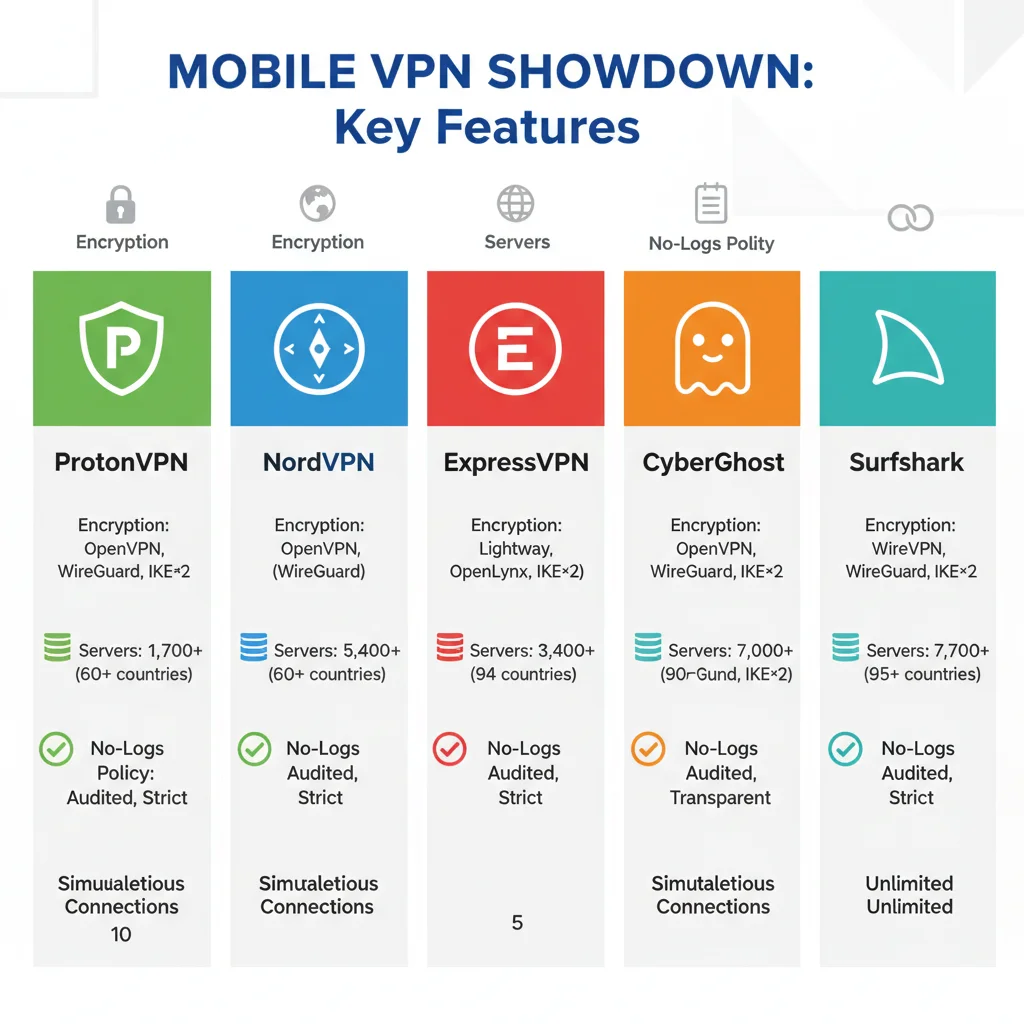
3. Surfshark: Budget-Friendly with Unlimited Devices
Overview: Surfshark has rapidly gained popularity for offering a premium VPN experience at an affordable price, notably allowing unlimited simultaneous connections. Based in the Netherlands, it’s a strong contender for users looking for secure mobile VPNs without breaking the bank in 2026.
Security Features:
- Encryption: AES-256-GCM encryption.
- Protocols: OpenVPN, IKEv2, and WireGuard.
- No-Logs Policy: Audited no-logs policy, ensuring your online activities are not recorded.
- Kill Switch: Available on mobile apps.
- DNS Leak Protection: Private DNS on every server.
- CleanWeb: Blocks ads, trackers, and malware.
- Camouflage Mode (Obfuscation): Hides your VPN usage from your ISP.
- MultiHop: Routes your connection through two VPN servers in different countries.
Performance: Good speeds, especially with WireGuard, making it suitable for streaming and general browsing. While not always as fast as ExpressVPN, it’s consistently reliable.
U.S. Server Presence: A solid network of servers across many U.S. states, providing good coverage and performance for American users.
Mobile App Experience: Clean, intuitive, and easy-to-use apps for iOS and Android, making it simple to connect and switch servers.
Pros: Unlimited simultaneous connections, affordable pricing, audited no-logs, strong security features, user-friendly apps.
Cons: Slightly slower speeds than top-tier competitors on some servers.
4. Proton VPN: Privacy by Design, Open-Source Transparency
Overview: Proton VPN, developed by the same team behind Proton Mail, is built with privacy and security at its core. Operating out of Switzerland, a country with strong privacy laws, it offers a robust solution for those prioritizing anonymity and transparency in 2026. It also offers a respectable free tier.
Security Features:
- Encryption: AES-256 encryption, 4096-bit RSA for key exchange, and HMAC with SHA384 for message authentication.
- Protocols: OpenVPN, IKEv2, and WireGuard.
- No-Logs Policy: Strict no-logs policy, independently audited.
- Kill Switch: Available on mobile apps.
- DNS Leak Protection: Ensures DNS requests are secure.
- Secure Core: Routes traffic through multiple servers in privacy-friendly countries before it leaves their network, offering superior protection against advanced attacks.
- NetShield: An ad, malware, and tracker blocker.
- Full Disk Encryption: All servers are fully encrypted.
- Open Source: All apps are open-source and independently audited, providing maximum transparency.
Performance: Offers good speeds, particularly with WireGuard. While not the absolute fastest, its focus on security does not significantly compromise performance for most mobile users.
U.S. Server Presence: A growing network of servers in various U.S. locations, providing reliable connections.
Mobile App Experience: Well-designed and feature-rich apps for iOS and Android, with a clear focus on security and user control. The free tier is a great way to experience their service.
Pros: Strongest privacy commitment, open-source and audited apps, Secure Core feature, based in Switzerland, free tier available.
Cons: Premium features can be more expensive, fewer server locations than some rivals.
5. Private Internet Access (PIA): Extensive Server Network and Customization
Overview: Private Internet Access (PIA) is a veteran in the VPN space, known for its massive server network, strong security, and highly customizable settings. Based in the U.S., it operates under a strict no-logs policy that has been proven in court multiple times, making it a reliable choice for secure mobile VPNs in 2026.
Security Features:
- Encryption: Configurable AES-128 or AES-256 encryption.
- Protocols: OpenVPN, WireGuard, and IKEv2.
- No-Logs Policy: Verified multiple times in court, demonstrating their commitment to not logging user data.
- Kill Switch: Available on mobile apps.
- DNS Leak Protection: Custom DNS servers to prevent leaks.
- MACE: Ad, tracker, and malware blocker.
- SOCKS5 Proxy & Port Forwarding: For advanced users seeking more control and specific use cases.
Performance: Offers consistently good speeds, especially with WireGuard. Its vast server network helps in finding less congested servers, contributing to better performance.
U.S. Server Presence: PIA boasts an incredibly extensive network of servers, with a very significant portion located within the U.S. This provides unparalleled choice and connection reliability for American users.
Mobile App Experience: Feature-rich apps for iOS and Android that allow for deep customization, appealing to users who want fine-grained control over their VPN settings. Can be a bit overwhelming for beginners.
Pros: Enormous server network (especially in the U.S.), court-proven no-logs policy, highly customizable, affordable pricing, good speeds.
Cons: U.S. jurisdiction might be a concern for some (though offset by court-proven no-logs), mobile apps can be complex for novices.
Understanding VPN Security and Privacy: Beyond the Marketing Hype
Choosing a secure mobile VPN goes beyond simply picking a popular name. It requires a deeper understanding of the underlying technologies and the provider’s operational philosophy. Here’s what else to consider:
Jurisdiction and "Five/Nine/Fourteen Eyes" Alliances
The country where a VPN company is based plays a crucial role in its privacy posture. Countries like the British Virgin Islands (ExpressVPN), Panama (NordVPN), and Switzerland (Proton VPN) are generally considered privacy-friendly due to their strong data protection laws and lack of mandatory data retention. The U.S. (PIA) is part of the "Five Eyes" intelligence-sharing alliance, which raises concerns for some users. However, PIA’s repeated court victories proving their no-logs policy help mitigate this concern significantly. It’s a balance between jurisdiction and a proven track record of privacy.
Independent Audits and Transparency Reports
In 2026, a truly secure mobile VPN will likely engage in regular, independent security audits of its infrastructure and no-logs policy. These audits provide third-party verification that the provider is living up to its promises. Transparency reports, which detail government requests for user data (and how the VPN responded, typically by stating they had no data to provide), also build trust.
Advanced Security Features Explained
- Obfuscation/Stealth VPN: This technology disguises your VPN traffic as regular internet traffic, making it harder for ISPs, governments, and network administrators to detect and block VPN usage. Useful in restrictive environments.
- Split Tunneling: Allows you to choose which apps or websites use the VPN connection and which bypass it. This is handy for accessing local network resources while maintaining VPN protection for other activities.
- Dedicated IP: Some VPNs offer the option to purchase a dedicated IP address, which can be useful for avoiding CAPTCHAs, accessing certain corporate networks, or running servers.
- Ad/Malware Blockers: Many VPNs now integrate features that block ads, malicious websites, and trackers at the DNS level, enhancing your browsing experience and security.
Performance Considerations for Mobile VPNs
While security is paramount, a VPN that’s too slow can be frustrating and impractical for daily mobile use. Here’s what impacts performance:
- Proximity to Servers: The closer you are to a VPN server, the better your speeds will generally be.
- Server Load: Overloaded servers can lead to slowdowns. VPNs with large server networks tend to have less congestion.
- VPN Protocol: WireGuard and proprietary protocols like Lightway (ExpressVPN) and NordLynx (NordVPN) are generally faster than OpenVPN and IKEv2.
- Device Processing Power: Older mobile devices might struggle with the encryption overhead, affecting speeds.
Our reviewed secure mobile VPNs generally offer excellent performance, with ExpressVPN and NordVPN often leading the pack in speed tests. Surfshark and PIA also provide very respectable speeds, especially when utilizing the WireGuard protocol.
Choosing the Right Secure Mobile VPN for Your Needs in the U.S.
The "best" VPN is subjective and depends on your individual priorities. Consider the following when making your decision:
- Your Budget: Surfshark and PIA offer excellent value, while ExpressVPN and NordVPN are premium options. Proton VPN has a great free tier.
- Number of Devices: If you need to protect many devices, Surfshark’s unlimited connections are a huge advantage.
- Speed Requirements: For heavy streaming, gaming, or large downloads, ExpressVPN or NordVPN might be preferred.
- Privacy Concerns: If extreme privacy and transparency are your top priority, Proton VPN with its open-source audited apps and Secure Core is a strong contender.
- Ease of Use: All listed VPNs have user-friendly mobile apps, but ExpressVPN and Surfshark are particularly intuitive for beginners.
- Customization: PIA offers the most granular control over settings, which advanced users might appreciate.
For most U.S. mobile users, any of these five secure mobile VPNs will provide a significant upgrade in data protection and online privacy. The key is to assess your specific usage habits and choose the provider that aligns best with your needs and comfort level regarding security, features, and price.
The Future of Mobile VPN Security: What to Expect Beyond 2026
The cybersecurity landscape is constantly evolving, and VPN providers are continuously adapting to new threats and technological advancements. Looking beyond 2026, we can anticipate several trends in secure mobile VPNs:
- AI-Powered Threat Detection: VPNs may integrate more sophisticated AI and machine learning algorithms to proactively identify and block emerging threats, not just known malicious sites.
- Quantum-Resistant Encryption: As quantum computing advances, VPNs will need to adopt quantum-resistant encryption algorithms to secure data against future decryption capabilities.
- Enhanced Decentralization: While still nascent, decentralized VPNs (dVPNs) could offer even greater anonymity by distributing network infrastructure, though they currently face performance and reliability challenges.
- Seamless Integration with OS: Deeper integration of VPN functionalities directly into mobile operating systems could simplify use and enhance overall security.
- Focus on IoT Security: As more everyday objects become connected, VPNs might expand their offerings to secure a wider range of IoT devices beyond traditional smartphones and tablets.
Staying informed about these developments will be crucial for maintaining robust mobile data protection in the years to come. For now, focusing on the core principles of strong encryption, audited no-logs policies, and reliable performance, as demonstrated by the secure mobile VPNs reviewed here, remains your best defense.
Conclusion: Securing Your Digital Life with the Right Mobile VPN
In 2026, the question "Is your VPN secure?" demands a nuanced answer, especially for mobile users in the United States. Our comprehensive review of ExpressVPN, NordVPN, Surfshark, Proton VPN, and Private Internet Access highlights that while all offer significant protection, they cater to slightly different needs and priorities. Each of these providers has demonstrated a strong commitment to security through robust encryption, advanced protocols, and, crucially, independently audited no-logs policies.
Whether you prioritize blazing speeds for streaming, an extensive feature set for advanced protection, budget-friendly unlimited connections, unparalleled transparency, or a massive U.S. server network, there is a secure mobile VPN on this list for you. Implementing a reliable VPN is no longer a luxury but a necessity for anyone serious about safeguarding their personal data and maintaining online privacy on their mobile devices.
By understanding the critical security features, evaluating performance, and considering your personal usage patterns, you can confidently choose a VPN that will stand as a formidable guardian of your digital life. Invest in a secure mobile VPN today, and take control of your online privacy in 2026 and beyond.