5 AI Trends Shaping Mobile App Development in the US for 2026: An Insider’s Guide to Growth
The landscape of mobile app development is in a constant state of flux, driven by rapid technological advancements and evolving user expectations. In the United States, a hub of innovation, the integration of Artificial Intelligence (AI) is not just a trend but a fundamental shift that is redefining how applications are conceived, built, and experienced. As we approach 2026, AI’s influence is set to become even more pervasive, offering unparalleled opportunities for developers and businesses to create more intelligent, intuitive, and impactful mobile solutions. This comprehensive guide delves into the AI Mobile App Trends that are poised to dominate the US market, providing an insider’s perspective on what to expect and how to prepare for this transformative era.
The strategic incorporation of AI into mobile applications goes beyond mere automation; it involves creating adaptive systems that learn from user behavior, predict needs, and deliver hyper-personalized experiences. From sophisticated recommendation engines to advanced natural language processing, AI is empowering apps to become indispensable tools in users’ daily lives. Understanding these emerging trends is crucial for any developer, entrepreneur, or business aiming to stay competitive and relevant in the fast-paced US mobile market. Let’s explore the five most significant AI Mobile App Trends that will shape the future of this dynamic industry by 2026.
1. Hyper-Personalization Driven by Predictive Analytics
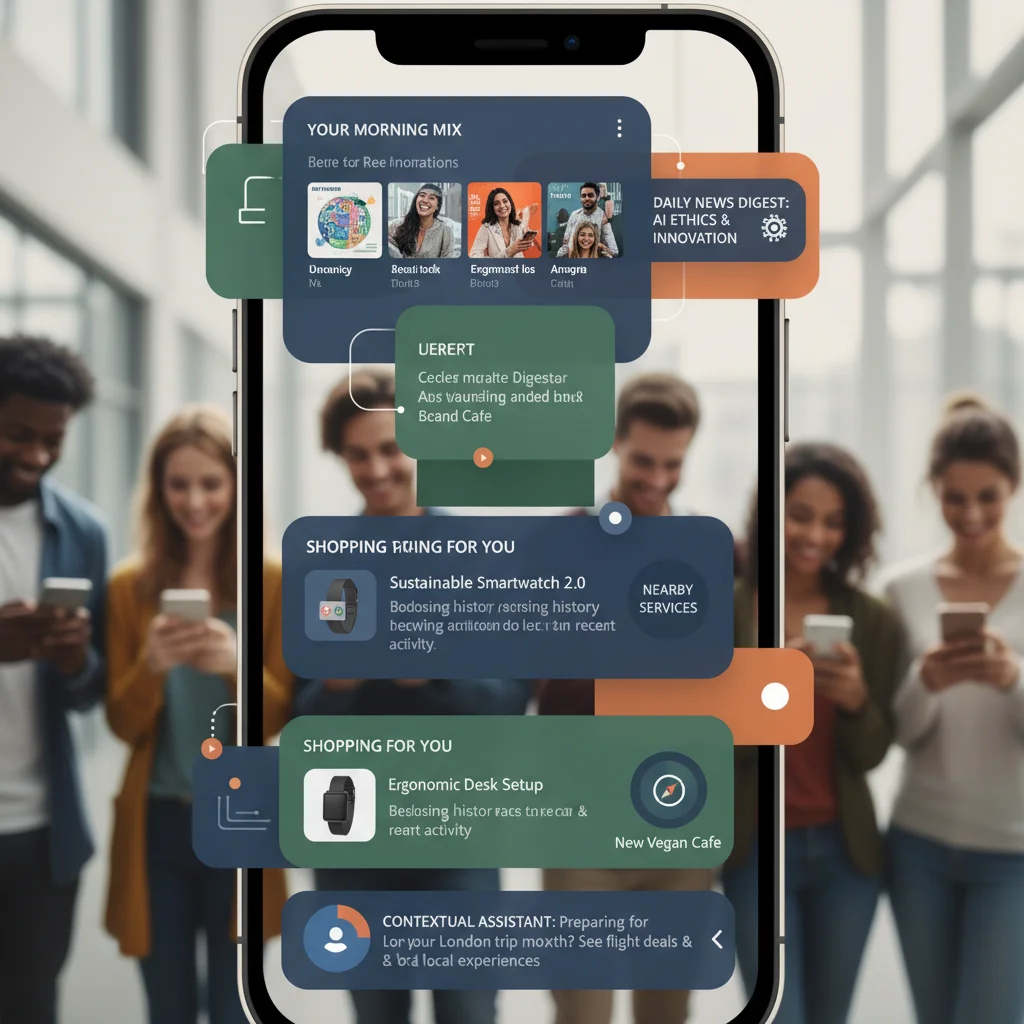
One of the most impactful AI Mobile App Trends is the relentless drive towards hyper-personalization, largely fueled by advanced predictive analytics. In an increasingly crowded app market, generic experiences no longer suffice. Users expect apps to understand their preferences, anticipate their needs, and deliver content, services, and recommendations that are uniquely tailored to them. By 2026, AI-powered predictive analytics will move beyond basic demographic segmentation to analyze individual user behavior patterns, contextual data (like location, time of day, and device usage), and even emotional cues to create truly bespoke app experiences.
Consider the evolution of recommendation engines. What started with simple ‘users who bought this also bought that’ algorithms has transformed into sophisticated AI models that can suggest not just products, but entire experiences, based on a deep understanding of a user’s lifestyle, past interactions, and stated preferences. For instance, a travel app might leverage AI to suggest not just destinations, but personalized itineraries, local experiences, and even dining options, all curated based on the user’s previous travel history, budget, and stated interests. Similarly, e-commerce apps will offer dynamic pricing, personalized promotions, and even custom product configurations presented in a way that resonates most with the individual user.
The technical underpinning of this trend lies in machine learning algorithms that process vast datasets to identify subtle correlations and predict future actions. Developers will increasingly rely on cloud-based AI services and sophisticated data pipelines to collect, clean, and analyze this information in real-time. The challenge, and opportunity, lies in striking the right balance between personalization and data privacy, a key consideration for US consumers. Apps that can transparently demonstrate how they use data to enhance the user experience, while maintaining robust security measures, will gain a significant competitive edge.
This level of personalization extends beyond content delivery. AI will enable apps to adapt their UI/UX dynamically, presenting information in a layout or format that is most effective for a particular user. For example, an educational app might adjust its learning pace and content difficulty based on a student’s performance and learning style. The goal is to make every interaction feel intuitive, efficient, and uniquely relevant, fostering deeper engagement and loyalty. The companies that master this hyper-personalization will not only retain users but also unlock new revenue streams through highly targeted offerings.
2. Advanced Conversational AI and Voice Interfaces
The rise of conversational AI and voice interfaces is another critical element among the top AI Mobile App Trends. While voice assistants like Siri, Google Assistant, and Alexa have been around for some time, their integration into mobile apps is set to become far more sophisticated and seamless by 2026. Users are increasingly comfortable interacting with technology through natural language, and AI is making these interactions more human-like, efficient, and context-aware.
Beyond simple commands, advanced conversational AI will enable multi-turn dialogues, understanding nuanced requests, and maintaining context across conversations. Imagine a banking app where you can verbally inquire about specific transactions, set up complex payment rules, or even get financial advice, all through a natural conversation. Or a healthcare app where you can describe symptoms, ask for medication reminders, and schedule appointments using voice commands, with the AI understanding medical terminology and providing empathetic responses.
This trend is driven by significant advancements in Natural Language Processing (NLP) and Natural Language Understanding (NLU), coupled with increasingly powerful speech-to-text and text-to-speech technologies. Developers will leverage AI models that can process accents, dialects, and even emotional inflections, leading to more accurate and satisfying voice interactions. Furthermore, multimodal AI, which combines voice with visual cues (e.g., a user pointing at an item on screen while asking a question), will become more prevalent, offering richer interaction possibilities.
For businesses, integrating advanced conversational AI means improved customer service, reduced operational costs, and enhanced user accessibility. Apps can provide instant support, answer FAQs, and guide users through complex processes without human intervention, available 24/7. It also opens doors for hands-free interactions, which is particularly beneficial for users who are multitasking or have accessibility needs. As US consumers become more accustomed to these intelligent interfaces in their daily lives, apps that fail to offer compelling conversational experiences risk falling behind. The focus will be on creating AI assistants that are not just functional but also personable and genuinely helpful, transforming the way users engage with their mobile devices.
3. Edge AI for Enhanced Performance and Privacy
The processing power of mobile devices has grown exponentially, paving the way for another significant development in AI Mobile App Trends: Edge AI. Instead of relying solely on cloud-based servers for AI computations, Edge AI involves performing AI processing directly on the device itself. This shift brings numerous advantages, including faster response times, reduced latency, improved privacy, and lower bandwidth consumption. By 2026, more and more AI functionalities within mobile apps will be executed on the edge.
Consider use cases like real-time image recognition, facial authentication, or gesture control. When these AI tasks are performed on the device, the data doesn’t need to be sent to the cloud for processing and then back to the device. This local processing means near-instantaneous results, crucial for applications requiring immediate feedback. For example, an augmented reality (AR) app that overlays digital information onto the real world benefits immensely from Edge AI, as it allows for seamless, lag-free interaction with the environment.
Privacy is another major driver for Edge AI. When sensitive data, such as biometric information or personal preferences, is processed locally on the device, it never leaves the user’s phone. This significantly reduces the risk of data breaches and enhances user trust, a paramount concern for consumers in the US. Developers will increasingly design apps with a ‘privacy-by-design’ approach, leveraging Edge AI to keep personal data secure and within the user’s control. Companies like Apple and Google are already heavily investing in on-device machine learning frameworks, making it easier for developers to integrate Edge AI capabilities into their apps.
Furthermore, Edge AI contributes to greater app reliability, especially in areas with limited or no internet connectivity. An app with on-device AI capabilities can continue to offer intelligent features even when offline, providing a more consistent and robust user experience. The challenge for developers will be optimizing AI models to run efficiently on mobile hardware, balancing performance with battery consumption. However, advancements in mobile chip design and specialized AI accelerators are making this increasingly feasible, solidifying Edge AI’s position as a transformative force in mobile app development.
4. Augmented Reality (AR) and Virtual Reality (VR) Enhanced by AI
The convergence of Augmented Reality (AR) and Virtual Reality (VR) with AI is set to revolutionize mobile experiences, marking a profound shift in AI Mobile App Trends. While AR/VR have been niche markets, the increasing sophistication of mobile hardware and AI algorithms will make these immersive technologies more accessible and practical for everyday mobile apps by 2026.
AI plays a crucial role in enhancing AR/VR experiences in several ways. For AR, AI-powered computer vision enables apps to accurately understand the real-world environment, recognize objects, track movement, and seamlessly overlay digital content. Imagine a shopping app where you can virtually try on clothes, place furniture in your home to see how it fits, or visualize how a new paint color would look on your walls, all with incredible realism and precision thanks to AI’s environmental understanding. Navigation apps could offer AI-powered AR overlays, guiding users with visual directions directly on their camera feed, recognizing landmarks in real-time.
In VR, AI contributes to more realistic simulations, intelligent non-player characters (NPCs) in games, and adaptive virtual environments. AI can learn user preferences within a VR space, customizing experiences or even generating dynamic content on the fly. For instance, a VR training simulation could adapt its scenarios based on the user’s performance and learning pace, providing a highly effective and personalized training experience. AI also enhances spatial audio and haptic feedback, making VR experiences more immersive and believable.
The US market, with its high adoption rates of cutting-edge technology, is ripe for the mainstreaming of AI-enhanced AR/VR mobile apps. From entertainment and gaming to education, retail, and professional tools, the applications are vast. Developers will need to master AI frameworks that support real-time object recognition, 3D mapping, and content generation to build these next-generation immersive experiences. The challenge will be optimizing these resource-intensive applications for mobile devices, ensuring smooth performance without excessive battery drain. However, as mobile chipsets become more powerful and specialized for AI and graphics processing, the potential for AI-driven AR/VR mobile apps is virtually limitless.

5. AI-Powered Security and Fraud Detection
As mobile apps become increasingly central to our financial, personal, and professional lives, the need for robust security is paramount. AI is emerging as a powerful ally in this battle, making AI-powered security and fraud detection a non-negotiable among future AI Mobile App Trends. By 2026, AI will be integral to protecting user data, preventing cyber threats, and ensuring the integrity of mobile transactions.
Traditional security measures often rely on predefined rules and signatures to detect known threats. AI, however, brings a dynamic and adaptive approach. Machine learning algorithms can analyze vast amounts of behavioral data, network traffic, and transaction patterns to identify anomalies that may indicate fraudulent activity or a security breach. For example, an AI system can learn a user’s typical login patterns, device usage habits, and transaction behaviors. Any deviation from these norms – such as a login from an unusual location, at an odd time, or a transaction exceeding typical amounts – can trigger an alert or additional verification steps.
This proactive threat detection is crucial for financial apps, e-commerce platforms, and any app handling sensitive user information. AI can detect sophisticated phishing attempts, malware, and even zero-day exploits that traditional security systems might miss. Furthermore, AI can be used for biometric authentication (facial recognition, fingerprint scanning, voice recognition) with enhanced accuracy and spoofing detection, adding an extra layer of security beyond passwords.
Beyond detecting external threats, AI also plays a role in identifying and mitigating internal vulnerabilities within the app itself. AI-assisted code analysis tools can scan for security flaws during the development process, helping developers build more secure applications from the ground up. The continuous learning capabilities of AI mean that security systems become more intelligent and effective over time, adapting to new attack vectors and evolving cyber threats.
The implementation of AI in mobile app security is not just about protection; it’s also about building user trust. Apps that can demonstrate superior security measures, powered by intelligent AI systems, will instill greater confidence in their users, leading to higher adoption rates and sustained engagement. In the US market, where data privacy and security concerns are high, this trend will be a critical differentiator for mobile app success.
The Road Ahead: Preparing for AI-Driven Mobile Development
The journey towards 2026 will see AI not just as an add-on feature but as the foundational layer for mobile app innovation. These AI Mobile App Trends – hyper-personalization, advanced conversational AI, Edge AI, AI-enhanced AR/VR, and AI-powered security – collectively paint a picture of a mobile ecosystem that is more intelligent, intuitive, and integrated than ever before. For developers and businesses in the US, embracing these trends is not merely an option but a necessity for future growth and competitive advantage.
To thrive in this AI-driven future, mobile app development strategies must evolve. This involves investing in AI talent, fostering a culture of continuous learning, and integrating AI frameworks and tools into the development lifecycle. Understanding the ethical implications of AI, particularly concerning data privacy, bias, and transparency, will also be paramount. Building trust with users through responsible AI deployment will be just as important as the technological prowess itself.
Furthermore, cross-platform development frameworks are increasingly incorporating AI capabilities, making it easier for developers to build AI-powered apps that reach a wider audience. Cloud providers are offering more robust AI-as-a-Service (AIaaS) solutions, democratizing access to powerful AI models and compute resources. This means even smaller development teams can leverage sophisticated AI without prohibitive upfront investment.
The opportunities presented by these AI Mobile App Trends are immense. From creating entirely new categories of applications to fundamentally transforming existing ones, AI will unlock unprecedented levels of user engagement, operational efficiency, and business value. Mobile app developers who proactively understand and integrate these trends into their strategies will be well-positioned to lead the next wave of innovation in the US market and beyond. The future of mobile is intelligent, and AI is its architect.
Conclusion: The Intelligent Evolution of Mobile Apps
The rapid acceleration of AI integration into mobile app development signifies a pivotal moment for the industry. The five key AI Mobile App Trends we’ve explored – hyper-personalization, advanced conversational AI, Edge AI, AI-enhanced AR/VR, and AI-powered security – are not isolated phenomena but interconnected forces driving a holistic evolution. By 2026, mobile applications in the US will be characterized by their uncanny ability to understand, assist, and protect users in ways that were once considered science fiction.
For businesses, this translates to deeper customer relationships, optimized operations, and new pathways for revenue generation. For developers, it means a stimulating environment ripe with technical challenges and creative possibilities. The focus will shift from merely building functional apps to crafting intelligent, adaptive ecosystems that seamlessly integrate into users’ lives, offering proactive solutions and anticipating needs before they are even articulated.
Staying at the forefront of these developments requires continuous learning, adaptability, and a commitment to innovation. As AI technologies continue to mature and become more accessible, the barrier to entry for integrating powerful AI features into mobile apps will decrease, democratizing intelligence across the app ecosystem. The US mobile market will undoubtedly be a crucible for these advancements, setting global benchmarks for what intelligent mobile experiences can achieve. The future is not just mobile; it’s intelligently mobile, and AI is leading the charge.