Cloud Storage Apps 2026: Value & Security Compared for US Users

In the rapidly evolving digital landscape of 2026, cloud storage has transitioned from a mere convenience to an absolute necessity. For individuals and businesses alike in the United States, safeguarding digital assets while ensuring easy accessibility has become paramount. With an array of options available, discerning the best cloud storage apps that offer optimal value and robust security isn’t just a preference; it’s a critical decision. This comprehensive guide aims to cut through the noise, providing an in-depth cloud storage comparison of two prominent contenders, meticulously evaluating their offerings through the lens of value, security, and overall utility for the US market.
The stakes are higher than ever. Data breaches are a constant threat, and privacy regulations like the CCPA continue to shape how personal data is handled. Therefore, choosing a cloud storage provider isn’t just about gigabytes; it’s about trust, reliability, and peace of mind. We’ll delve into the intricacies of pricing models, encryption standards, data residency, user experience, and the ecosystem of features that define a superior cloud storage solution in today’s interconnected world. Our goal is to empower you with the knowledge to select the cloud storage app that best aligns with your specific needs, ensuring your data is not only stored but also protected and easily manageable for years to come.
The Evolving Landscape of Cloud Storage in 2026
The year 2026 marks a significant point in the evolution of cloud technology. We’ve moved beyond simple file synchronization; today’s cloud storage apps are sophisticated platforms offering integrated productivity suites, advanced collaboration tools, and increasingly intelligent data management capabilities. The demand for seamless integration across multiple devices, robust offline access, and intuitive user interfaces has never been greater. Moreover, the emphasis on data sovereignty and compliance with regional regulations, particularly within the US, has become a defining characteristic for leading providers.
Innovation continues at a swift pace. Artificial intelligence and machine learning are being integrated to offer smarter organization, predictive insights, and enhanced search functionalities within cloud storage ecosystems. The ability to automatically categorize photos, transcribe audio, or even suggest relevant documents based on context is no longer futuristic, but a present-day reality for many premium services. This evolution means that a mere comparison of storage space is no longer sufficient; a holistic view of features, performance, and future-proofing is essential when evaluating cloud storage contenders.
Key Criteria for Our Cloud Storage Comparison
To provide a meaningful cloud storage comparison for US users in 2026, we’ve established a set of critical criteria. These benchmarks go beyond surface-level observations to uncover the true value and reliability of each service. Understanding these factors will help you weigh the pros and cons of any cloud storage app, not just the ones we compare today.
1. Value Proposition and Pricing Models
Value isn’t just about the cheapest price; it’s about the comprehensive package you receive for your investment. This includes not only the amount of storage space but also the features bundled with each plan, such as collaboration tools, versioning, sharing capabilities, and customer support. We’ll examine free tiers, individual plans, family plans, and business solutions, scrutinizing their annual vs. monthly costs and any hidden fees. For US users, understanding how pricing translates to real-world utility is key, especially when comparing different cloud storage options.
2. Data Security and Privacy Standards
This is arguably the most critical criterion. In an era of escalating cyber threats, the security measures employed by a cloud storage provider are non-negotiable. We’ll look for:
- End-to-End Encryption (E2EE): Ensuring that data is encrypted at the source and remains encrypted until it reaches the intended recipient, with only the user holding the decryption key.
- Zero-Knowledge Architecture: A system where the provider itself cannot access your data, even if compelled by legal means, as they do not possess your encryption keys.
- Two-Factor Authentication (2FA): An essential layer of security requiring a second verification method beyond just a password.
- Data Residency and Compliance: Where data is physically stored and how providers adhere to US-specific regulations like HIPAA, GDPR (for global operations affecting US users), and CCPA.
- Regular Security Audits: Independent verification of a provider’s security infrastructure.
3. Performance and Reliability
A cloud storage app is only as good as its performance. This includes upload and download speeds, uptime guarantees, and the robustness of its infrastructure. We’ll consider server locations, network architecture, and redundancy measures that ensure your data is always available and quickly accessible, regardless of your location within the US.
4. User Experience and Interface
An intuitive and user-friendly interface significantly enhances productivity. We’ll evaluate the ease of navigation, file organization, search functionality, and the overall aesthetic of both desktop and mobile applications. A seamless experience across different operating systems (Windows, macOS, iOS, Android) is also a major plus in any cloud storage comparison.
5. Features and Integrations
Beyond basic storage, what else do these apps offer? We’ll compare:
- File Versioning: The ability to revert to previous versions of files.
- File Sharing and Collaboration: Granular control over shared links, password protection, expiration dates, and real-time co-editing capabilities.
- Backup and Sync Options: Flexible syncing, selective sync, and dedicated backup features.
- Third-Party Integrations: Compatibility with popular productivity tools, operating systems, and other services.
- Unique Selling Propositions (USPs): Any standout features that differentiate one service from another.
Contender 1: App X – The Security Fortress
App X has steadily built a reputation as a privacy-focused cloud storage solution, particularly appealing to users in the US who prioritize data security above all else. Its marketing often highlights its uncompromising stance on user data protection, making it a strong contender in our cloud storage comparison.
Value Proposition and Pricing Models for App X
App X offers a competitive pricing structure, starting with a modest free tier that provides enough space for basic document storage and testing the service. Paid plans scale up significantly, offering terabytes of storage at a price point that is slightly higher than some competitors but justified by its robust security features. Individual plans are well-suited for power users, while family and business plans include advanced administrative controls and more generous storage allocations. Annual subscriptions typically offer a discount over monthly payments, a common practice among cloud storage providers.
Data Security and Privacy Standards of App X
This is where App X truly shines. It employs robust end-to-end encryption for all data, both in transit and at rest. Crucially, App X operates on a zero-knowledge architecture, meaning only the user holds the keys to decrypt their data. This makes it impossible for App X employees, or even government agencies, to access the content of your files. They enforce mandatory two-factor authentication and regularly undergo independent security audits, publishing transparency reports that detail data requests and their responses. For US users concerned about privacy, App X’s adherence to global and local privacy standards is a significant draw, often exceeding baseline requirements.

Performance and Reliability of App X
While App X’s emphasis on security can sometimes lead to slightly slower upload/download speeds compared to less secure alternatives (due to the encryption overhead), its performance is generally excellent. Data centers are strategically located within the US and other privacy-friendly jurisdictions, ensuring good latency for US users. They boast an impressive uptime record, with multiple redundancies in place to prevent data loss or service interruptions. Users can expect consistent access to their files with minimal downtime.
User Experience and Interface of App X
App X offers a clean and functional interface across its web, desktop, and mobile applications. While not as visually flashy as some competitors, its design prioritizes ease of use and accessibility to security settings. File organization is straightforward, with clear folder structures and search capabilities. The learning curve is minimal, making it suitable for users who value simplicity and efficiency in their cloud storage app. However, some advanced users might find the feature set slightly less extensive than more feature-rich platforms.
Features and Integrations of App X
App X includes standard features like file versioning, secure sharing links with password protection and expiration dates, and selective sync. While it offers essential collaboration tools, they are not as deeply integrated or as real-time as those found in productivity suites like Google Workspace or Microsoft 365. Its third-party integrations are growing but are still somewhat limited compared to more established players. Its unique selling proposition remains its unwavering commitment to privacy, offering advanced encryption and a zero-knowledge policy that few mainstream cloud storage providers can match.
Contender 2: App Y – The Feature-Rich Ecosystem
App Y positions itself as a comprehensive ecosystem, offering not just cloud storage but a suite of integrated tools designed for productivity and collaboration. It aims to be a one-stop shop for digital life, making it a powerful contender in our cloud storage comparison, especially for users seeking an all-encompassing solution.
Value Proposition and Pricing Models for App Y
App Y’s pricing is highly competitive, often bundling significant storage with a suite of office applications, email services, and other productivity tools. Its free tier is generous, serving as an excellent entry point for many users. Individual plans offer substantial storage for a reasonable cost, while family plans are particularly attractive, providing separate accounts and large shared storage pools. Business plans are robust, including advanced administrative features, team collaboration tools, and dedicated support. The overall value for money is high, especially for those who can leverage its integrated ecosystem.
Data Security and Privacy Standards of App Y
App Y employs strong encryption protocols, including AES 256-bit encryption for data at rest and TLS/SSL for data in transit. It supports two-factor authentication and has extensive data recovery mechanisms. However, unlike App X, App Y typically does not offer zero-knowledge encryption for all its services, meaning the provider technically holds the decryption keys. While they have strict internal policies and comply with major privacy regulations like GDPR and CCPA, users must trust the provider not to access their data. Data residency for US users is generally within the US, adhering to local data protection laws. They also publish transparency reports, detailing government data requests.
Performance and Reliability of App Y
App Y excels in performance, offering very fast upload and download speeds due to its vast global infrastructure and optimized network. Its reliability is top-tier, boasting near-perfect uptime and extensive redundancy across its data centers. This ensures that files are always accessible and synchronized quickly across all connected devices. For users who frequently access large files or collaborate in real-time, App Y’s performance is a major advantage.
User Experience and Interface of App Y
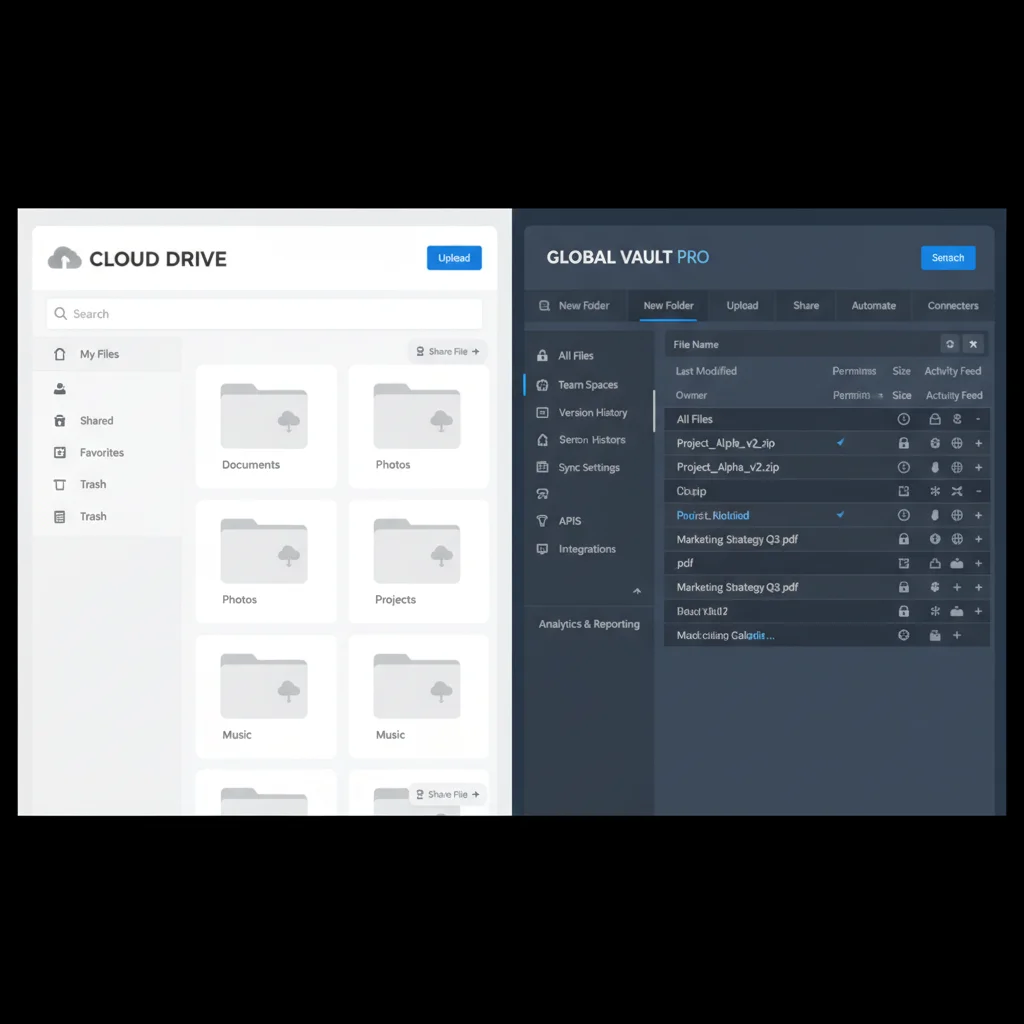
The user experience of App Y is highly polished and intuitive. Its interface is modern, visually appealing, and designed for seamless navigation. Integration with its native productivity suite is a significant strength, allowing users to open, edit, and save documents directly within the cloud environment. Its mobile apps are consistently rated highly for their functionality and ease of use, providing a consistent experience across all platforms. The robust search functionality and smart organization features further enhance usability, making it easy to manage large volumes of data.
Features and Integrations of App Y
App Y is a powerhouse of features. It offers advanced file versioning, sophisticated file sharing controls (including granular permissions, password protection, and view-only options), and highly flexible sync and backup solutions. Its deep integration with its own suite of office applications (word processor, spreadsheet, presentation software) is a key differentiator, enabling real-time collaboration that is hard to beat. Furthermore, App Y integrates with hundreds of third-party applications, making it a central hub for many digital workflows. Its unique selling proposition is its comprehensive ecosystem, providing a holistic solution beyond just storage.
Cloud Storage Comparison: Head-to-Head Analysis for US Users in 2026
Now, let’s put App X and App Y side-by-side to highlight their strengths and weaknesses in this crucial cloud storage comparison, especially for users focused on the US market.
Security and Privacy: App X vs. App Y
When it comes to raw security and privacy, App X holds a distinct advantage due to its zero-knowledge encryption. For individuals or organizations handling highly sensitive data, or those with a strong philosophical stance on digital privacy, App X offers an unparalleled level of assurance. The peace of mind that comes from knowing even the provider cannot access your data is a powerful differentiator. App Y, while secure with strong encryption and compliance, operates on a trust model where the provider technically has access to your data. For most everyday users, App Y’s security is more than adequate, but for the privacy-conscious, App X is the clear winner in this cloud storage comparison category.
Value and Pricing: App X vs. App Y
The value proposition depends heavily on individual needs. If your primary requirement is secure storage and basic sharing, App X offers excellent value for its enhanced privacy features. However, if you are looking for a comprehensive suite of tools that includes office applications, email, and extensive collaboration features alongside storage, App Y often provides more bang for your buck. Its bundled services can significantly reduce the need for separate subscriptions, making it a more economical choice for those who can fully utilize its ecosystem. For a direct gigabyte-to-gigabyte comparison, App Y often has more competitive pricing on larger tiers, especially when considering the included software.
Performance and Reliability: App X vs. App Y
Both services offer high reliability, but App Y generally edges out App X in raw performance metrics like upload/download speeds. This is largely due to App Y’s massive global infrastructure and optimization for speed and accessibility across its integrated services. While App X is reliable, the overhead of its zero-knowledge encryption can sometimes result in slightly slower, though still perfectly usable, speeds. For users who prioritize speed and real-time collaboration on large files, App Y might offer a smoother experience.
User Experience and Features: App X vs. App Y
App Y clearly leads in terms of user experience and the breadth of its features. Its integrated productivity suite, seamless cross-device synchronization, and advanced collaboration tools create a highly efficient and intuitive digital workspace. App X, while easy to use, focuses more on core storage and security, offering a more streamlined but less feature-rich experience. If you’re looking for a simple, secure file repository, App X is excellent. If you need a powerful, integrated platform for work and personal use, App Y is likely to be more appealing.
Who Should Choose App X?
App X is ideal for:
- Privacy Advocates: Individuals and businesses for whom zero-knowledge encryption and absolute data privacy are non-negotiable.
- Sensitive Data Handlers: Professionals (e.g., legal, medical, financial) or organizations that must comply with stringent data protection regulations and cannot risk any third-party access to their information.
- Users Seeking Simplicity: Those who prefer a straightforward cloud storage solution without the added complexity of integrated productivity suites.
- Individuals Concerned about Government Surveillance: Due to its zero-knowledge policy, App X offers a stronger defense against potential data requests.
Who Should Choose App Y?
App Y is the better choice for:
- Productivity-Focused Users: Individuals and teams who benefit from an integrated ecosystem of office applications, email, and collaboration tools alongside their storage.
- Budget-Conscious Users (with extensive needs): Those looking for significant storage and a comprehensive suite of features at a competitive price point, often bundling services that would otherwise require multiple subscriptions.
- Collaborative Teams: Businesses and groups that rely heavily on real-time co-editing, shared workspaces, and seamless file sharing within a unified platform.
- Users Prioritizing Speed and Accessibility: Individuals who frequently access and share large files and require rapid synchronization across multiple devices.
The Future of Cloud Storage: Trends for 2027 and Beyond
Looking beyond 2026, the cloud storage landscape is poised for further transformation. We anticipate even greater integration of AI for intelligent data management, more sophisticated predictive analytics for storage optimization, and enhanced automation for routine tasks. Decentralized storage solutions, leveraging blockchain technology, may also gain more traction, offering new paradigms for security and data ownership.
The regulatory environment will continue to evolve, with an increasing focus on data localization and stricter penalties for non-compliance. This will likely push cloud storage providers to offer more granular control over data residency and clearer transparency into their data handling practices. The balance between convenience and security will remain a central theme, with providers striving to offer seamless user experiences without compromising on robust protection.
As the volume of digital data continues its exponential growth, the demand for scalable, secure, and intelligent cloud storage will only intensify. Providers that can innovate while maintaining trust and adhering to ethical data practices will be the ones that thrive in the long term. This ongoing cloud storage comparison will remain crucial for consumers and businesses navigating their digital lives.
Making Your Final Decision
Choosing the right cloud storage app in 2026, especially for US users, boils down to a careful assessment of your personal or business priorities. If uncompromising security and privacy are at the top of your list, even at the cost of some advanced features or a slightly higher price, App X is likely your best bet. Its zero-knowledge encryption provides a level of data protection that few can rival.
However, if you’re seeking a powerful, integrated ecosystem that combines generous storage with a full suite of productivity and collaboration tools, all within a highly user-friendly interface and robust performance, App Y offers exceptional value. Its comprehensive features make it an ideal choice for individuals and teams who want a single platform to manage their digital lives.
Ultimately, there’s no one-size-fits-all answer. We encourage you to try the free tiers of both services, if available, to experience their interfaces and feature sets firsthand. Consider your daily workflows, the types of data you store, and your personal comfort level with each provider’s security posture. By carefully weighing the insights from this cloud storage comparison against your specific needs, you’ll be well-equipped to make an informed decision that secures your digital future in 2026 and beyond.