Voice Productivity Tools 2026: Save 1 Hour Daily

Leveraging Voice-Activated Productivity Tools: A 2026 Guide for US Professionals to Save 1 Hour Daily
In the relentlessly fast-paced professional landscape of 2026, time is not just money; it’s the ultimate currency for success, innovation, and work-life balance. US professionals are constantly seeking an edge, a method to reclaim precious minutes from their demanding schedules. Enter the transformative power of voice productivity tools. No longer a futuristic fantasy, these advanced, AI-driven solutions are poised to revolutionize how we work, offering a tangible path to saving at least an hour every single workday. This comprehensive guide will delve into the cutting-edge of voice technology, exploring how it can be integrated into your professional life to dramatically boost efficiency and reclaim your time.
The evolution of voice technology has been nothing short of remarkable. From basic dictation software to sophisticated AI assistants capable of understanding complex commands and context, the capabilities have expanded exponentially. In 2026, these tools are more intuitive, more accurate, and more integrated into our digital ecosystems than ever before. For the discerning professional, understanding and harnessing these advancements is no longer optional; it’s a strategic imperative. Imagine delegating routine tasks, drafting emails, scheduling meetings, and even conducting research, all through the power of your voice. This isn’t just about convenience; it’s about optimizing every facet of your workday, freeing you to focus on high-value activities that truly drive your career forward.
The Dawn of Hyper-Efficient Voice Productivity Tools in 2026
The year 2026 marks a pivotal moment for voice productivity tools. Advancements in natural language processing (NLP) and machine learning (ML) have propelled these technologies beyond simple speech-to-text. Today, we’re talking about intelligent systems that can learn your preferences, anticipate your needs, and execute multi-step commands with remarkable precision. This section explores the core innovations driving this new era of productivity.
AI-Powered Voice Assistants: Your New Digital Co-Pilot
Forget the rudimentary voice assistants of yesteryear. In 2026, AI-powered voice assistants are sophisticated digital co-pilots, seamlessly integrated across devices and platforms. These aren’t just for setting alarms; they are powerful tools for managing your professional life. Think about an assistant that can:
- Draft emails and reports: Simply speak your thoughts, and the AI structures them into professional correspondence or detailed reports, complete with proper grammar and formatting.
- Manage your calendar and schedule meetings: Request your assistant to find availability, send invitations, and even follow up with attendees, all without touching your keyboard.
- Conduct real-time research: Need a quick fact or statistic during a call? Your voice assistant can retrieve it instantly, feeding you the information through your earpiece.
- Automate workflows: Set up routines where a voice command triggers a series of actions, such as ‘Start my workday’ which could open necessary applications, check your top priorities, and provide a weather update.
The key to maximizing these assistants lies in consistent use and training. The more you interact with them, the better they understand your unique speech patterns, vocabulary, and professional context, leading to even greater efficiency gains.
Advanced Dictation Software: Beyond Transcription
While dictation software has been around for decades, 2026 versions are in a league of their own. Accuracy rates are near-perfect, even in noisy environments, thanks to advanced noise cancellation and contextual understanding. But the real game-changer is what comes after transcription:
- Automatic Formatting and Styling: Dictate a document, and the software can automatically apply headings, bullet points, and even specific branding guidelines.
- Integrated Editing Tools: Make corrections and refinements using voice commands, such as ‘delete that paragraph,’ ‘move this sentence before the last one,’ or ‘capitalize the next word.’
- Multilingual Support: Seamlessly switch between languages or dictate in one language and have the output automatically translated into another, perfect for global professionals.
- Industry-Specific Vocabulary: Specialized versions of dictation software are now commonplace, pre-loaded with medical, legal, or technical jargon, ensuring precise transcription in niche fields.
For professionals who spend a significant portion of their day typing, this advancement alone can shave off hours, allowing for more fluid thought processes and reduced physical strain.
Smart Devices and Wearables: Voice Everywhere
The proliferation of smart devices and wearables means voice productivity tools are no longer confined to your desktop. Smartwatches, true wireless earbuds with integrated AI, and even smart glasses are becoming essential components of a voice-activated workflow. Imagine:
- Responding to emails discreetly through your earbuds while commuting.
- Taking hands-free notes during a site visit using a smart pen that transcribes and organizes your thoughts.
- Receiving urgent notifications and responding verbally without pulling out your phone.
This omnipresence of voice technology ensures that you can remain productive and responsive, regardless of your physical location or whether your hands are free. It blurs the lines between work and personal life in a positive way, enabling quick tasks to be handled efficiently as they arise, preventing them from accumulating.
Strategic Integration: Saving Your First Hour with Voice Productivity Tools
Understanding the tools is one thing; strategically integrating them into your daily routine to genuinely save an hour is another. This section provides actionable strategies for US professionals to maximize the benefits of voice productivity tools.
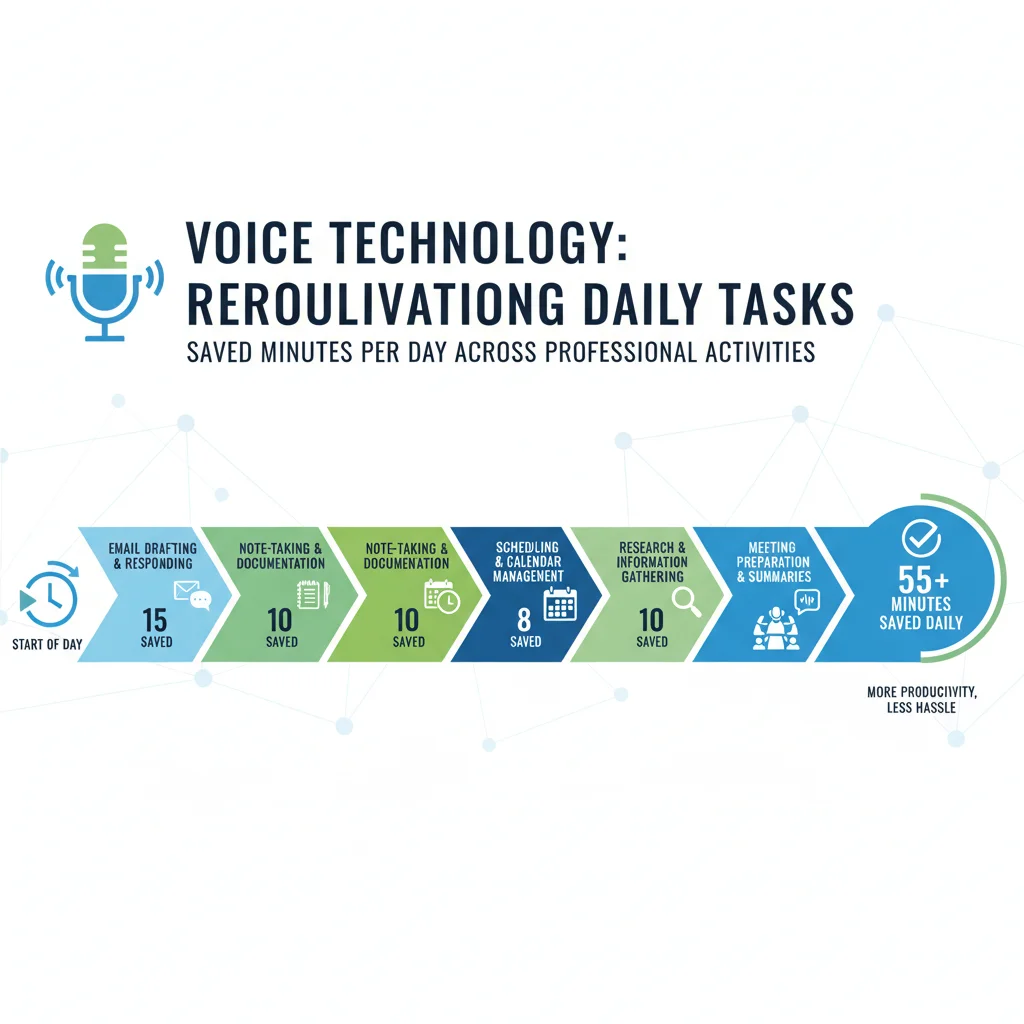
Morning Routine Optimization (15-20 minutes saved)
Start your day by reclaiming minutes. Instead of manually sifting through emails and calendars, let your voice assistant do the heavy lifting:
- Daily Briefing: As you get ready, ask your AI assistant for a summary of your top emails, calendar appointments, and priority tasks for the day. This provides a quick, hands-free overview, allowing you to mentally prepare without screen time.
- Quick Responses: Respond to non-urgent emails or draft initial thoughts for urgent ones verbally. Many professionals find they can articulate their thoughts more clearly and quickly when speaking rather than typing.
- Commute Productivity: If you have a driving commute, use the time to dictate meeting notes, brainstorm ideas, or even listen to summaries of industry news provided by your voice assistant. For public transport commuters, discreetly use your earbuds to manage tasks.
Meeting and Note-Taking Revolution (20-25 minutes saved)
Meetings are often productivity black holes. Voice productivity tools can transform them into efficient information hubs.
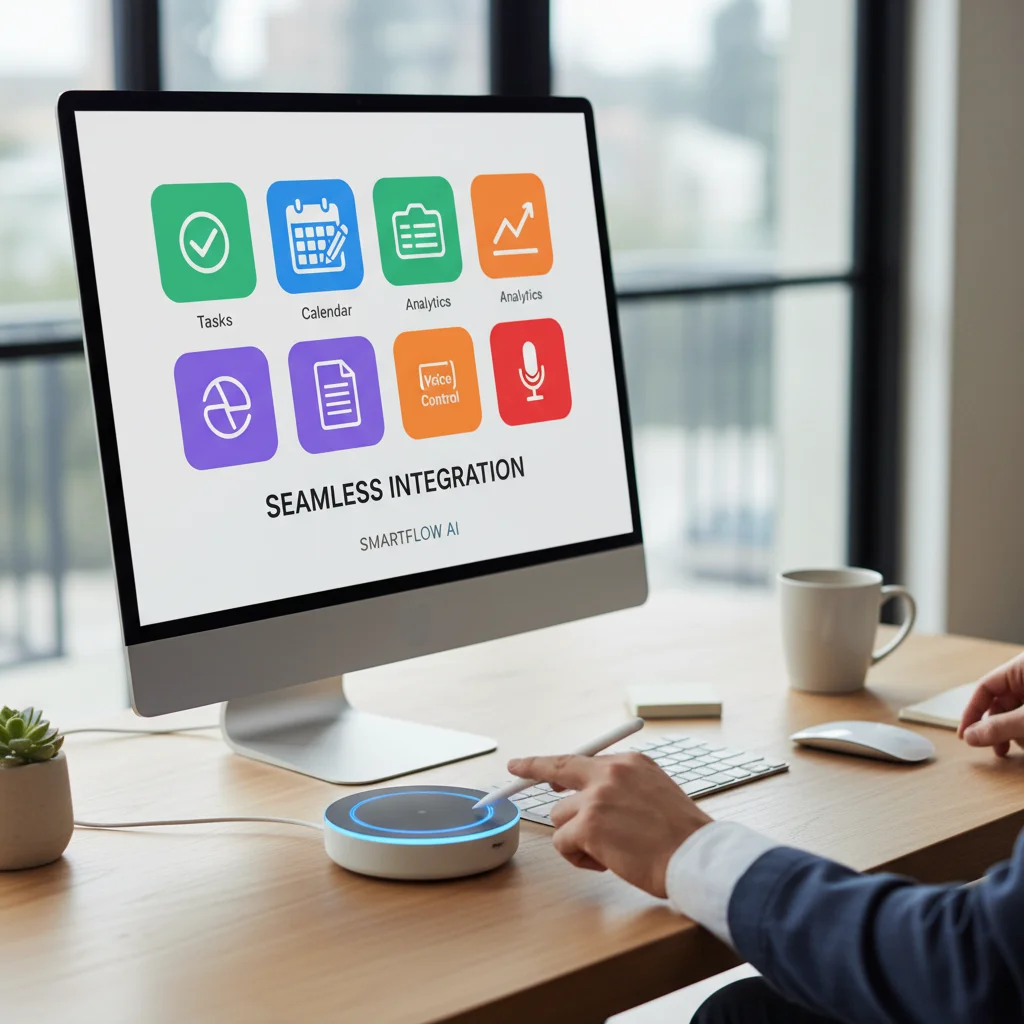
- Automated Transcription: Utilize AI-powered meeting transcription services that not only transcribe the entire meeting but can also identify speakers, summarize key discussion points, and even flag action items. This frees you from meticulous note-taking.
- Voice-Activated Action Items: During the meeting, simply state, “Assistant, create an action item for John to follow up on the Q3 report by Friday,” and it’s logged into your project management tool.
- Post-Meeting Summaries: Have your voice assistant generate a concise summary of the meeting, highlighting decisions made and next steps, which can be instantly shared with attendees. This eliminates the need for manual summary writing.
Email and Document Creation Acceleration (15-20 minutes saved)
The sheer volume of writing tasks can be daunting. Dictation and AI assistance can drastically cut down on this time.
- Drafting Emails and Reports: Instead of typing, speak your emails, proposals, or reports. The speed of speech is significantly faster than typing for most individuals. Focus on content and flow, letting the voice tool handle the text generation.
- Voice Commands for Editing: Once dictated, use voice commands to edit, format, and refine your documents. This keeps your hands free and your focus on the content, rather than hunting for keys.
- Template Integration: Many advanced dictation tools can integrate with your existing document templates, automatically populating fields or applying standard formats, further reducing manual effort.
Task Management and Reminders (5-10 minutes saved)
Keeping track of tasks and deadlines is crucial. Voice tools make this effortless.
- Instant Task Creation: As soon as a task comes to mind, simply say, “Assistant, add ‘review Q4 budget’ to my to-do list for tomorrow morning.” It’s logged instantly, preventing forgotten tasks.
- Contextual Reminders: Set location-based or time-based reminders with your voice. “Remind me to call Sarah when I get to the office,” or “Remind me about the team meeting 10 minutes before it starts.”
- Project Updates: Update project statuses or log progress reports verbally, integrating directly with your project management software.
Choosing the Right Voice Productivity Tools for US Professionals
With a plethora of options available, selecting the best voice productivity tools can seem overwhelming. This section offers guidance on making informed choices for your specific professional needs.
Key Features to Look For:
- Accuracy and Natural Language Understanding (NLU): This is paramount. The tool must accurately transcribe your speech and understand your intent, even with nuanced commands. Look for tools with high NLU scores and adaptive learning capabilities.
- Integration Capabilities: Does it seamlessly integrate with your existing professional ecosystem (e.g., Microsoft 365, Google Workspace, CRM systems, project management software)? The less friction, the more effective the tool.
- Security and Privacy: Especially for sensitive professional data, ensure the tool offers robust encryption, data privacy policies, and compliance with relevant regulations (e.g., HIPAA, GDPR, CCPA).
- Customization and Personalization: Can you train the tool to understand your specific vocabulary, industry jargon, or preferred commands? Personalization significantly enhances efficiency.
- Multi-Device Compatibility: Look for tools that work across your desktop, laptop, tablet, smartphone, and wearables for true omnipresent productivity.
- Offline Functionality: While less common, some advanced tools offer limited offline capabilities, which can be crucial for professionals working in areas with unreliable internet access.
Top Voice Productivity Tools to Consider in 2026:
While specific product names can change rapidly in the tech landscape, here are categories and examples of leading contenders in the voice productivity tools space:
- Advanced Dictation Suites: Look for solutions like ‘Dragon Professional Anywhere’ or cloud-based alternatives that leverage enterprise-grade AI for superior accuracy and customization.
- Integrated AI Assistants: Beyond general consumer assistants, consider enterprise-focused AI assistants that integrate deeply with business applications, offering advanced scheduling, data retrieval, and workflow automation. Companies like Microsoft (Cortana for Enterprise), Google (Google Assistant for Business), and Amazon (Alexa for Business) are continuously enhancing their offerings.
- Meeting Transcription Services: Tools like ‘Otter.ai Business’ or ‘Zoom AI Companion’ offer real-time transcription, speaker identification, and AI-powered summaries, often integrating directly into video conferencing platforms.
- Smart Note-Taking Devices: Digital smart pens that transcribe handwritten notes and spoken thoughts simultaneously, or voice recorders with embedded AI for organization and summarization, are gaining traction.
Before committing, always leverage free trials or demos to assess how well a tool fits your unique workflow and technical environment. User reviews and industry reports from reputable sources can also provide valuable insights.
Overcoming Challenges and Maximizing Your Voice Productivity Tools Investment
While the benefits of voice productivity tools are immense, there can be a learning curve. Addressing potential challenges proactively will ensure you fully realize the promised time savings.
Addressing Accuracy and Understanding
- Speak Clearly and Naturally: While modern tools are advanced, clear articulation still yields the best results. Avoid mumbling or speaking too quickly.
- Train Your Assistant: Most advanced tools offer personalization features. Take the time to train the AI with your voice, accent, and specific vocabulary. The initial investment in training will pay dividends in accuracy.
- Use Contextual Cues: Provide as much context as possible, especially for complex commands. Instead of just “Schedule a meeting,” try “Schedule a meeting with the marketing team on the Q4 strategy for next Tuesday afternoon.”
- Invest in Quality Hardware: A good quality microphone, especially a noise-canceling headset, can significantly improve transcription accuracy, particularly in open-plan offices or busy home environments.
Integration and Workflow Adoption
- Start Small: Don’t try to overhaul your entire workflow at once. Begin by integrating voice tools for one or two specific tasks where you feel the most time drain, such as email drafting or meeting notes.
- Establish Routines: Create specific voice-activated routines for daily tasks. Consistency helps you and the AI learn and adapt.
- Explore Custom Commands: Many advanced tools allow for custom commands or macros. Identify repetitive tasks in your workflow and create voice commands to automate them.
- Team Training and Adoption: If you’re implementing these tools for a team, ensure everyone receives adequate training and understands the benefits. Collective adoption amplifies efficiency gains.
Security and Data Privacy Concerns
- Understand Data Handling: Familiarize yourself with the privacy policies of the voice tools you use. Know how your voice data and transcribed text are stored, processed, and used.
- Secure Network Usage: Always use voice tools over secure, encrypted networks, especially when dealing with confidential information.
- Enterprise-Grade Solutions: For corporate environments, prioritize enterprise-grade voice solutions that offer enhanced security features, compliance certifications, and robust data governance policies.
- Regular Updates: Keep your voice software and associated operating systems updated to benefit from the latest security patches and feature enhancements.
The Future of Work: A Voice-First Professional World
Looking beyond 2026, the trajectory of voice productivity tools points towards an even more interconnected and intuitive professional world. We are rapidly moving towards a ‘voice-first’ paradigm where natural language interaction becomes the primary mode of engagement with our digital tools and environments.
Predictive AI and Proactive Assistance
Future voice assistants will not just respond to commands; they will anticipate your needs. Imagine an AI that proactively suggests relevant documents before a meeting, drafts an email response based on context, or even identifies potential scheduling conflicts before you do. This predictive capability will further reduce cognitive load and decision-making time.
Hyper-Personalized Digital Environments
Your digital workspace will become increasingly personalized through voice. AI will learn your working style, preferred tools, and even your emotional state, adjusting interfaces and prioritizing information to optimize your productivity and well-being. This could mean a voice command that instantly reconfigures your desktop layout, pulls up specific project dashboards, and filters notifications based on your current focus.
Augmented Reality (AR) and Voice Integration
The convergence of AR and voice technology will unlock entirely new dimensions of productivity. Professionals could interact with virtual data overlays in their physical environment using voice commands. For example, during a factory tour, an engineer could verbally query a machine’s maintenance history, with the information appearing as an AR overlay on the machine itself. This hands-free, context-aware interaction will redefine field work and collaborative design.
Ethical AI and Trust
As voice tools become more integral, ethical considerations around data privacy, algorithmic bias, and the nature of human-AI collaboration will become even more critical. Professionals and organizations will need to engage with tools that prioritize transparency, user control, and responsible AI development to build trust and ensure beneficial outcomes.
Conclusion: Reclaim Your Time with Voice Productivity Tools
The promise of saving an hour a day might seem ambitious, but with the advanced voice productivity tools available to US professionals in 2026, it is an entirely achievable goal. By strategically integrating AI-powered assistants, sophisticated dictation software, and smart devices into your daily workflow, you can dramatically enhance your efficiency, reduce mental fatigue, and free up valuable time for more strategic thinking, creativity, and personal pursuits.
The key lies in embracing these technologies not just as gadgets, but as fundamental shifts in how we interact with our digital world. Start by identifying your biggest time sinks, then explore how voice commands can streamline those processes. Invest in quality tools, dedicate time to learning their capabilities, and adapt your routines to leverage their full potential. The future of work is voice-activated, and by stepping into this future today, you’re not just saving an hour; you’re investing in a more productive, balanced, and successful professional life.
Don’t let the opportunity to optimize your workday slip away. Embrace the power of voice and experience a new level of professional efficiency that will set you apart in the competitive landscape of 2026 and beyond.